

The Elite 8 isn't like the other rounds.
March Madness betting gets weird by the time eight teams are left. Casual money peaks. Everyone has an opinion on which #1 seed is "destined" for the Final Four. The market reflects that confidence in the lines.
If you're betting this round, that overconfidence is your friend.
The Elite 8 has the most consistent underdog edge of any round in the tournament. It's also where seed-based thinking costs bettors the most. Below: 40 years of data, sample sizes on every number.
Where most bettors go wrong
The public trusts seeds too much at this stage. By the Elite 8, every remaining team has won three tournament games. The #11 seed still alive has beaten three decent opponents. The #1 seed that cruised through the first weekend might not have faced real pressure yet.
But the market still prices seeds like they're predictive.
Higher seeds are just 50-46 SU (n=96 games since 2000). That's a coin flip. Against the spread, it's worse: 36-56-4 ATS, a 39% cover rate on 96 games since 2000.
If you're betting the better seed because "they're supposed to win," you're paying for a narrative.
The other mistake? Laying small numbers. Favorites of -4 or less are 3-10-1 ATS in recent Elite 8 games (23%, n=14). Since 1998, they cover at just 34% in this range. Short favorites here are paying juice on a coin-flip game.
The trends, one by one
Underdogs are the play
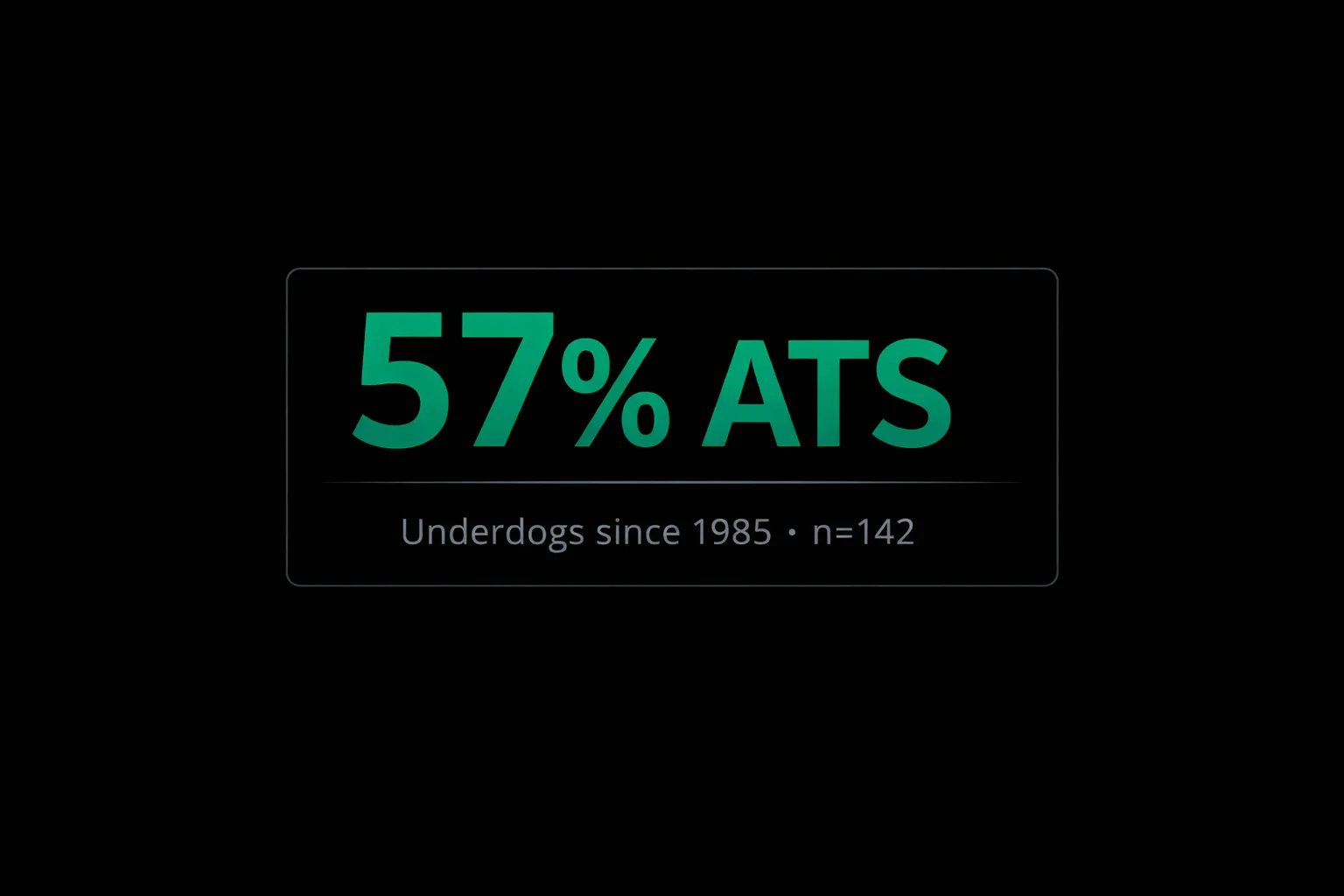
This is the headline stat with the biggest sample. Underdogs are 80-60-2 ATS (57%) since 1985 across 142 games. In smaller, more recent windows, it's even sharper: 33-21-2 ATS (61%, n=56).
Moneyline dogs aren't just covering. They win outright at a near-50% clip: 26-30 SU in recent windows (n=56). In most rounds, taking a dog on the moneyline is reckless. In the Elite 8, the data says otherwise.
Why? By this point, the talent gap between teams is thin. The dogs still alive have earned it. Public money still floods in on favorites, which inflates lines. Value sits on the other side.
Seeds are overvalued
We covered higher-seed ATS numbers above. But #2 seeds deserve a separate look.
#2 seeds cover roughly 70% of the time in Elite 8 spots. They're often matched up against #1 seeds, and the market tends to overvalue the top line. Public backs #1, books adjust, and #2 seeds become the value play.
That mispricing pattern repeats year after year.
Spreads are less predictive here
Only 7 of 56 Elite 8 games (12.5%) have landed exactly on the spread. Games in this round tend to go one of two ways: the dog wins outright, or the favorite wins comfortably.
That "spread-sensitive" middle ground from the regular season barely exists here. It's one reason moneyline dogs carry extra weight in the Elite 8. If the dog is going to cover, there's a decent chance they're winning the game outright.
Unders have a structural edge
Since 2018, overs have hit just 42% across all March Madness games. In the Elite 8, the lean gets even stronger.
It comes down to pace. Everything slows. Possessions become more deliberate. Elite defenses are overrepresented this deep in the bracket. The eight teams left are the ones that get stops.
Books still set totals using regular-season pace data. When the tournament shifts to half-court, high-pressure basketball, those totals are too high more often than not.
Sweet 16 + Elite 8 is peak dog value
Zoom out one more level: since 2005, underdogs are 61-46 ATS across Sweet 16 and Elite 8 games combined. That's a positive ROI window in a tournament where most rounds are closer to a coin flip.
Public confidence peaks in the later rounds and the lines show it. Value flips to dogs. This two-round window has been the most profitable stretch in the bracket for over a decade.
How to actually use this
Base rates aren't a blind system. Not every dog is a play, and not every under is a play. The data gives you a starting framework.
What to look for in an Elite 8 underdog:
Guard play matters here more than any other round. Teams that rely on guards who handle pressure, create their own shot, and limit turnovers tend to outperform their seed. The Elite 8 is where composure beats raw talent.
Check defensive efficiency next. If the dog ranks in the top 40 nationally in adjusted defensive efficiency, that pairs well with the under lean. Good defense keeps games close, and close games are where dogs cover.
Look at recent form too. Not "vibes" form. Measurable form: last 5-10 games, margin of victory trend, and performance against tournament-caliber opponents.
What to fade:
Laying -3 to -5 on a favorite in this round. The data is ugly: 23% ATS across 14 recent games. Backing a #1 seed on reputation alone. And betting overs without confirming both teams actually play at a pace that supports the total.
Putting it together
Saturday night. #1 Duke is -3.5 against #2 Alabama. Public money hammers Duke. The total is 148.5, set off regular-season pace numbers.
Everything here says: fade the short favorite, look at Alabama on the spread or moneyline, and lean under unless both teams rank top 25 in tempo.
None of that is a guarantee. It's a framework backed by 40 years of results. The edge isn't in any single trend. It's in stacking multiple data points that all lean the same direction.
The quick version
The Elite 8 is the best round in the tournament for underdog bettors, and the data goes back decades.
- Dogs cover 57% ATS (n=142 since 1985)
- Short favorites cover just 23% ATS (n=14 recent games)
- Higher seeds cover 39% ATS (n=96 since 2000)
- Totals lean under (overs hit 42% since 2018)
- ML dogs win outright nearly half the time (n=56)
If you're doing this research manually, you know how long it takes to pull historical ATS data, cross-reference seeds, and check defensive matchups. WagerLens puts trend data and matchup stats in one place so you can focus on the analysis, not the data collection.
The dogs are barking. Good luck this weekend.