
MLB Playoff Hitter Props: Total Bases, H+R+RBI and Walks, Explained
MLB playoff hitter props count different things: total bases count bases from hits, H+R+RBI adds hits, runs and RBIs, and walks count bases on balls. Research the exact market and line, confirm the lineup, consider the starter and bullpen, then compare the price. A walk helps a walks prop but adds nothing to total bases.
October makes that distinction expensive to miss. Your hitter can reach base twice, score a run and still lose an over 1.5 total bases bet. He had a productive night. You bought a different stat.
This is the batter companion to our MLB playoff pitcher props guide. The method applies throughout the postseason; the dated LCS examples below show what was actually available when checked, including missing quotes.
How each hitter prop is scored
Use the official box score, not how far a runner traveled. MLB's total bases definition credits only hits.
| Market | How it's counted |
|---|---|
| Total bases | Single 1; double 2; triple 3; homer 4 |
| Hits | One per official hit, including extra-base hits |
| H+R+RBI | Hits + runs scored + RBIs |
| Home runs | One per official homer |
| Walks | Bases on balls (BB), not hit-by-pitches |
| Singles | One per official single, not extra-base hits |
What is a total bases prop?
Over 1.5 total bases needs at least two bases from hits. One double wins; two singles win. One single followed by a stolen base does not. Over 2.5 needs at least three.
A home run contributes four total bases, regardless of runners on base. A three-run homer isn't worth more total bases than a solo homer.
What does hits + runs + RBIs mean?
An H+R+RBI prop adds three box-score columns. A solo homer contributes one hit, one run and one RBI: three in total. A double contributes one hit, not two; runs and RBIs can add to it separately.
A batter can contribute without a hit. A walk followed by a run scored adds one run. A bases-loaded walk can earn an RBI. MLB's RBI definition also covers run-scoring outs, with exceptions such as grounding into a double play. Don't count every run that scores during a plate appearance as an RBI.
Do walks count toward total bases?
No. A walk adds zero hits and zero total bases. For a batter walks over 0.5 prop, one qualifying walk is enough; two aren't required.
Intentional walks count as walks in MLB's statistics, but read your sportsbook's market rules before assuming how it settles them. Also check starting-lineup requirements, extra innings, shortened games and postponements. The statistical definition and the book's action rules are separate.
Whole-number lines deserve another look. Exactly two at a standard over 2.0 line can push, while over 2.5 loses at two. A "2+" milestone means at least two. Make sure your research matches the bet slip.
What changes in October
Better starters, but don't stop at the starter
Playoff opponents can present tougher pitching than the mix in a regular-season log. That doesn't make every under attractive. Check the actual starter's handedness, strikeout rate, walk rate and contact allowed against the hitter's side.
For total bases, contact quality and extra-base power matter. For walks, the hitter's patience and the pitcher's control matter more. H+R+RBI also depends on who reaches base ahead of him and who can drive him home.
Shorter starter leashes and changing bullpens
A good matchup against the starter might cover only the first two plate appearances. Managers can go to the bullpen earlier, especially with rested relievers after an off-day. Or recent heavy usage can leave fewer reliable options.
Research likely relievers and their handedness, not just the starter's season average. Don't assume October means a rested bullpen every night. The pitcher guide covers the other side of that workload question.
Lineup and platoon shifts
Wait for the confirmed order. Moving from second to seventh can reduce opportunities; a platoon hitter also risks losing a later plate appearance to a pinch-hitter.
H+R+RBI needs lineup context on both sides of the hitter. A patient batter can get on base and remain stranded. A power hitter can be pitched around. Check who's hitting behind him before treating either scenario as an automatic benefit.
Tiny samples get loud
Two big nights can dominate a broadcast and a recent-game chart. They're still two nights.
Use the longer record as your starting point, then ask whether the current role, health or pitching matchup changed. A short postseason-only split is useful context, not a replacement for the rest of the season.
A 5-step research checklist for hitter props
- Name the exact bet. Player, market, over or under, line and book. Total bases and H+R+RBI aren't interchangeable. Separate main lines from alternates.
- Confirm opportunities. Starting status, batting order, platoon risk and any sourced injury note. A missing injury note doesn't prove the hitter is healthy.
- Check the pitching plan. Starter's handedness and relevant splits, likely relievers, recent bullpen usage, park and roof or weather conditions.
- Read the games behind the rate. Use X of Y games with dates at this exact line. Compare windows, look for pinch-hit appearances, and distinguish regular-season from postseason games.
- Check price and freshness. Match the same side and line across books. Read the quote timestamp, confirm the number at the sportsbook, and pass if the evidence isn't enough.
For the wider matchup process, read how to research MLB player props. For repeatable habits rather than one-night narratives, use our MLB prop betting strategy guide.
LCS examples (as of Oct 8, 2026, 5:07 PM ET)
These are examples, not picks. Two NLCS home-run checks were available for Dodgers at Brewers on Sunday, Oct 11. Total bases, H+R+RBI and walks weren't posted on the player pages checked for this game. Don't substitute a home-run trend for a total-bases trend.
The WagerLens matchup pages display 8:00 PM ET for NLCS Game 1. MLB's schedule feed still marked the start time TBD when checked, so that time isn't independently confirmed here. Verify first pitch on MLB's postseason schedule.
Jackson Chourio: over 0.5 home runs, example, not a pick
Chourio's NLCS check showed 3 of 15 games (20%), Sep 16 to Oct 7. That's a mixed regular-season and Division Series window, not 15 playoff games.
The best-price panel said no book quotes were available. A separate price-history chart displayed +525, but that isn't a verified current offer. Without a fresh quote, there isn't a current priced bet to evaluate.
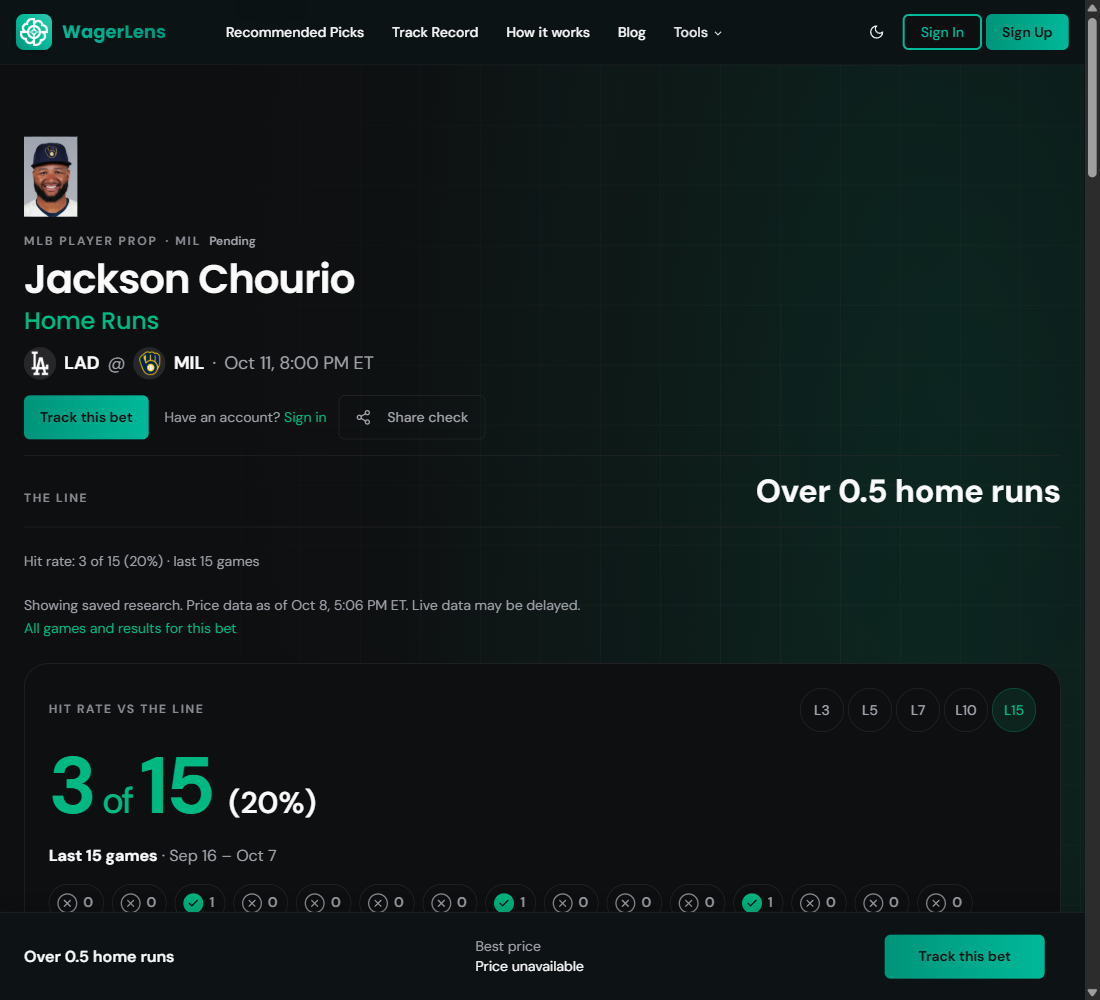
Check Chourio's player page again when more NLCS markets post. His home-run rate doesn't answer whether over 1.5 total bases is worth the price.
William Contreras: over 0.5 home runs, example, not a pick
Contreras's NLCS check showed 4 of 15 games (27%), Sep 12 to Oct 7. Again, the window mixes regular-season and postseason games.
This check also lacked a usable best-price quote, despite +625 appearing in price history. The larger observed hit rate alone doesn't make Contreras the better bet. Price, opportunities and matchup still matter.
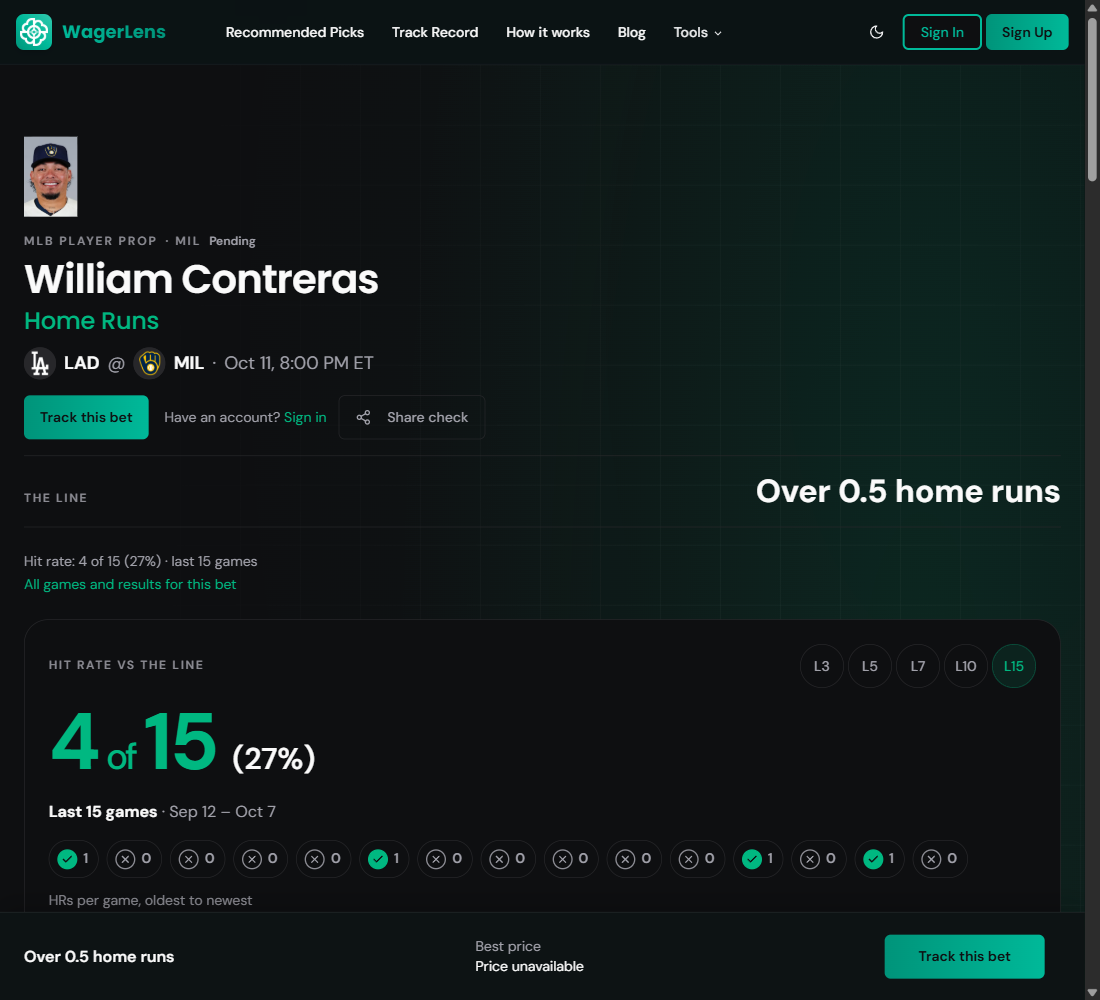
Contreras's player page is the place to recheck posted markets. For ALCS player props, the Rays open Monday, Oct 12; the schedule feed still listed their opponent as CLE/CWS. No fresh LCS batter example was verified for Tampa Bay in this snapshot.
Small samples in October
A real walks example shows the problem. Contreras over 0.5 walks against San Diego on Oct 7 had pregame research of 2 of 3 games (67%), Oct 3 to Oct 6. The recorded closing price was +165 at Fanatics, Oct 7 at 9:27 PM ET.
It lost: Contreras finished with zero walks. This is a settled Division Series example, not an active LCS offer.
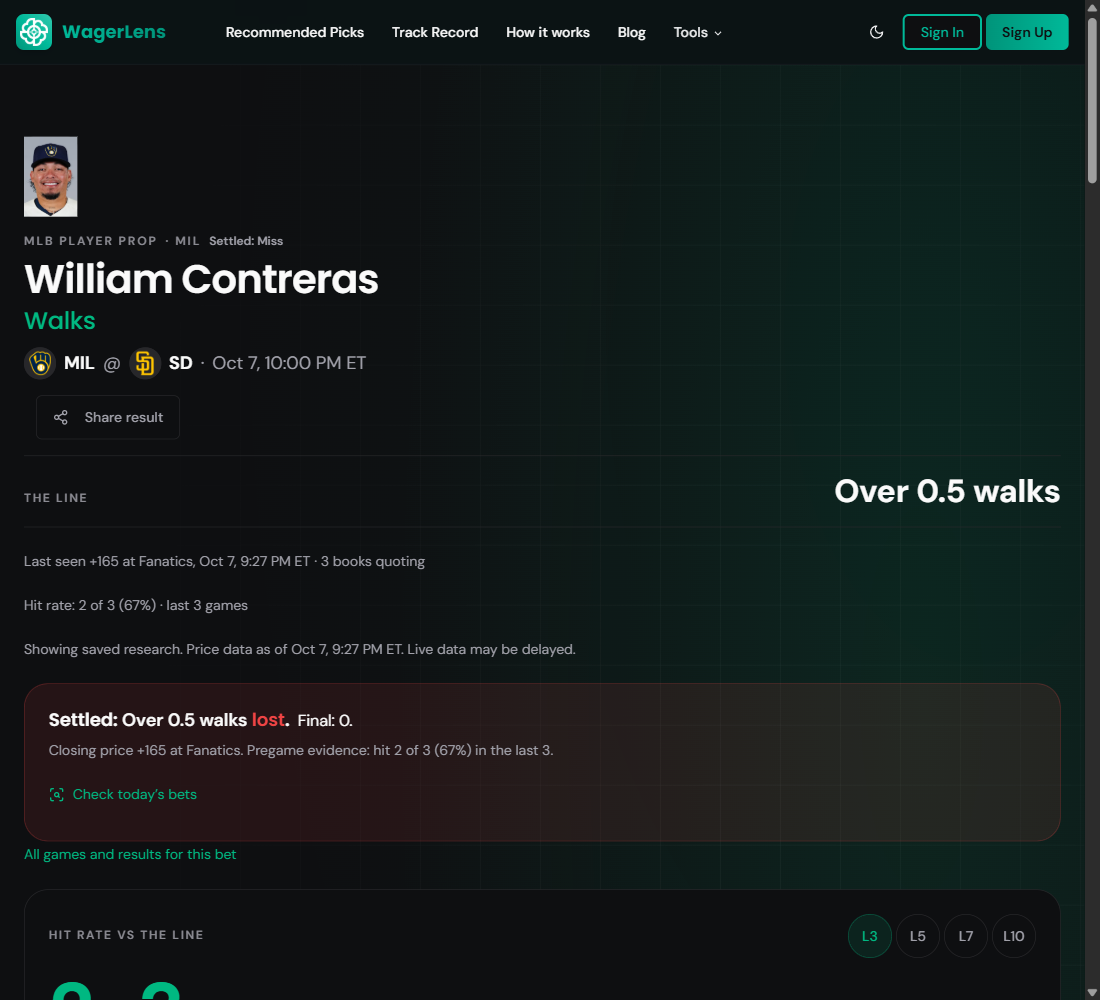
At +165, the break-even rate is about 37.7%, calculated as 100 / 265. Comparing that with 67% from three games doesn't prove value. Each result changes a three-game rate by roughly 33 percentage points.
Read how to interpret prop hit rates before turning a short streak into a win probability. The denominator matters as much as the percentage.
Check your own hitter prop
Open Bet Check and enter your actual bet with the player's full name, market, side and line. Confirm the restated match before reading the numbers.
Bet Check is free with no account. Read the sample window, game log and available price with its timestamp. If the market isn't posted, the match fails or prices are missing, don't treat a different prop as the answer.
Keep researching
Compare availability on today's MLB props board, and use the pitcher companion to research the opposing arm. Our public track record includes losses; no dated performance figure is copied here.
WagerLens is a research tool, not a sportsbook. No prop is a sure thing. Bet only what you can afford to lose, and don't chase a postseason loss. For gambling support in the U.S., call 1-800-GAMBLER.
Frequently asked questions
What is a total bases prop?
It counts bases from hits: single = 1, double = 2, triple = 3, home run = 4. Over 1.5 needs at least two, such as a double or two singles.
Do walks count toward total bases?
No. Only hits add total bases. Walks, hit-by-pitches, steals and later advances don't count. A walk can still lead to a run or a bases-loaded RBI in H+R+RBI.
What is an H+R+RBI prop?
It adds hits, runs scored and RBIs. A solo homer contributes three: one hit, one run and one RBI. A double contributes one hit, not two, before any runs or RBIs.
Are playoff hitter props riskier than regular-season ones?
They aren't automatically worse bets. Playoff-only samples are small, and pitching plans or lineup roles can change quickly. Start with a larger sample, check the lineup and likely relievers, and don't treat a short streak as a forecast.
Is Bet Check free for MLB props?
Yes, for supported MLB props, with no account. Enter the player, market, side and line, then confirm the match. Missing prices or thin samples are limits to investigate, not evidence of an edge.
See it live before you bet
MLB props with best prices, hit rates with sample sizes, and a public track record.
- Every pick graded — wins and losses, no filters
- Hit rates for the exact line and recent windows
- Sportsbook price comparison on free Bet Checks
- Premium adds tracking, history and stats, and alerts
- Public track record with wins and losses