
How to read prop hit rates (and why sample size matters)
A prop hit rate is the share of games in a set window where a player cleared a specific line, written as X of Y (pct%) plus that window. "7 of 10 (70%), last 10 games" tells you the result, the sample and the time frame in one line. Leave out the Y and the window, and the percentage alone can't tell you much.
You'll see hit rates everywhere this time of year: "4/4" on a props screen, "80%" in a post, a fire emoji on a streak. Here's how to read them like someone who checks the receipts.
Have a prop in mind already? Check it free. Bet Check shows the hit rate at your line, the window behind it and the best tracked price.
What a prop hit rate is
A hit rate answers one narrow question. In this window, how often did this player clear this exact number?
Every hit rate is tied to three things:
- A market. Receptions, receiving yards, strikeouts, pitcher outs and so on.
- A line. Over 2.5 receptions isn't the same bet as 5+ receptions.
- A window. Last 5 games, last 10, season to date, or whatever range the tool shows.
Change any one of those and you get a different rate. That's expected, not a bug.
Why "X of Y" beats a bare percentage
A bare "75%" hides the denominator. Two rates can share a percentage and carry very different evidence.
Example (illustrative numbers, not a real player): 3 of 4 (75%) and 30 of 40 (75%) look identical on a percentage-only screen. Add one miss to each and the first drops to 3 of 5 (60%), while the second only slips to 30 of 41 (73%).
That's why we always write the rate as X of Y with a window. Before you trust a percentage, ask how many games it came from and when those games were played.
How many games is enough?
We won't hand you a magic number, because there isn't an honest one. What we can show is how much one game moves a small sample.
Illustrative arithmetic: in a 4-game window, one extra over moves the rate 25 percentage points. In a 20-game window, the same single over moves it 5 points. The math is honest either way, but the small window is far noisier.
So treat small samples as a starting point, not a verdict. Look for a longer window when the tool offers one, and ask whether those games still look like the player's current situation.
Hit rate vs implied probability
A high hit rate isn't automatically a good bet. The price tells you how often the bet has to win just to break even, and that's the number your hit rate has to beat.
American odds convert to an implied probability. Use the vig calculator to see what any price implies and how much margin the book built in.
Example (illustrative odds, not a live quote): a prop at -150 needs to win 60% of the time to break even. A 7 of 10 (70%) hit rate sits above that, but it's 10 games, and one miss in either direction moves it 10 points. A 6 of 10 (60%) rate at +120, which needs about 45.5%, is a different research question.
Neither example is a recommendation. The point is that rate and price have to be read together, and a better payout doesn't make the case for a side by itself. For more on how prices vary by book, see our line shopping guide.
Line-specific hit rates and ladders
Ladders like 3+, 4+, 5+ and 6+ receptions are separate lines. Each rung has its own X of Y, and the rate usually falls as the number climbs.
Here's a real example from a WagerLens Bet Check (not a pick). Kyle Pitts went under 2.5 receptions in 3 of 3 games (100%), last 3 games, Sep 13 to Sep 24, with 0, 1 and 1 catches, oldest to newest. By the same game log, he cleared 3+ receptions in 0 of 3 (0%), so every higher rung was 0 of 3 too. Data as of Oct 5, 2026, 1:01 PM ET.
Three games is a tiny sample, and it'll change after Monday night's game. You can follow his lines on the Kyle Pitts props page.
When a line moves, re-read the rate at the new number. If an over you liked at 61.5 yards is now 64.5, the hit rate at 61.5 doesn't apply anymore.
Reading early-season NFL samples
Through Week 4, most NFL season-to-date windows hold four games or fewer. A 100% or 0% rate in that range is history with a small denominator, not a trend you can lean on.
Two habits help. First, look at a longer window where WagerLens shows one, including last season if the player's role and team are the same. Second, ask what changed: a new quarterback, an injury ahead of him on the depth chart or a scheme shift can make older games less relevant.
Context doesn't replace the sample. It tells you how much weight the sample deserves. Our guide to researching NFL player props walks through role, matchup and price checks that sit alongside the hit rate.
How to read a WagerLens Bet Check
Here's the Pitts check from the ladder example, captured Oct 5, 2026. Tap the screenshot to see it full size.
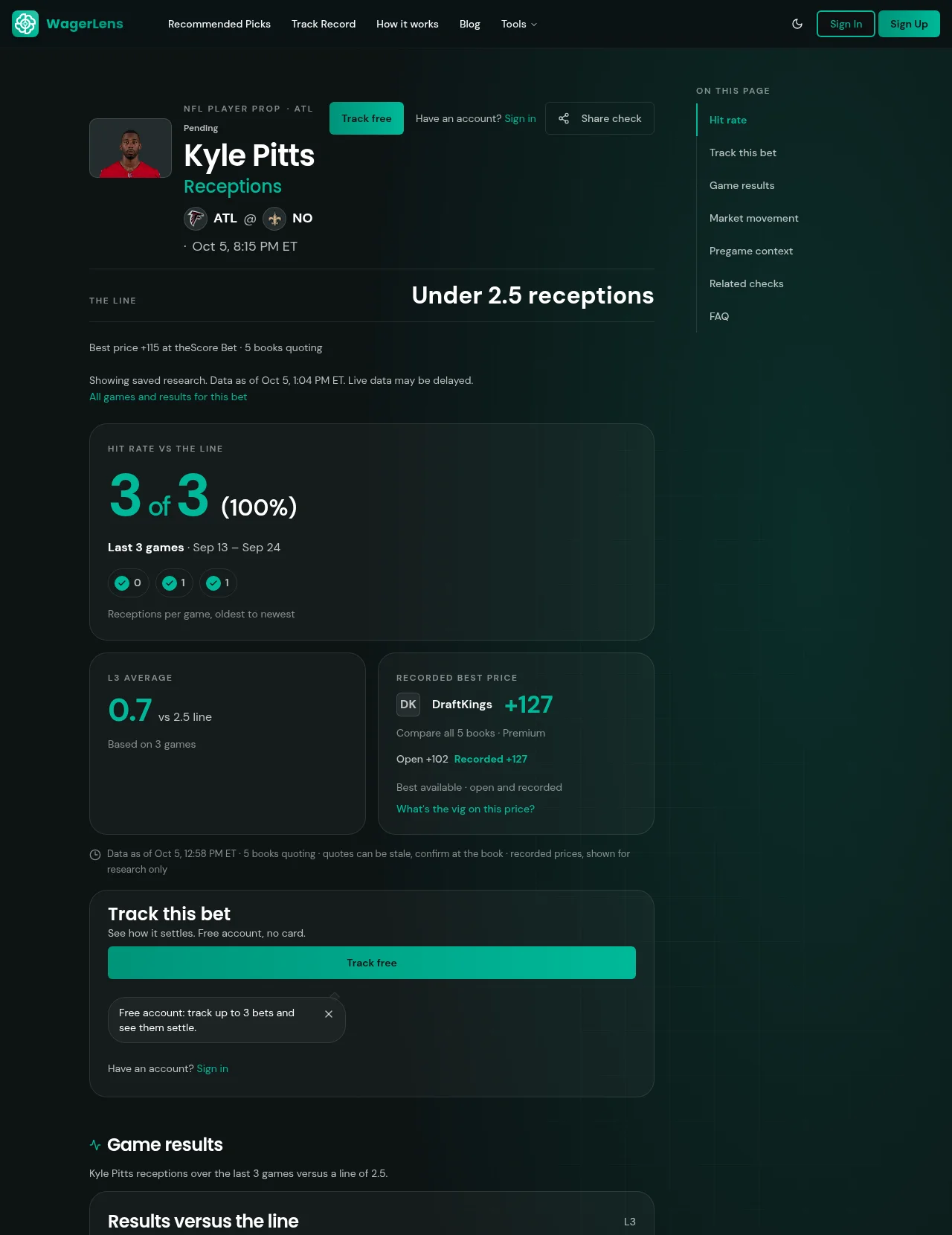
Bet Check for Kyle Pitts under 2.5 receptions, ATL at NO. Data as of Oct 5, 2026, 1:04 PM ET.
Read it from the top down:
- The line. Market, side and number: under 2.5 receptions.
- Best price. The best tracked quote and how many books are quoting it. At capture, the top of the page showed +115 at theScore Bet with 5 books quoting.
- Hit rate vs the line. The X of Y (pct%), the window and its dates: 3 of 3 (100%), last 3 games, Sep 13 to Sep 24. On checks with longer histories, L5, L10 and L15 buttons let you switch windows.
- Per-game results. Each game's number, oldest to newest, so you can see the path and not just the percentage.
- Average vs the line. The L3 average was 0.7 against a 2.5 line, based on 3 games.
- Recorded best price. The open and the latest recorded price, with its own timestamp. At capture it showed open +102 and recorded +127 at DraftKings, data as of 12:58 PM ET.
- Game results and market movement. A game log with hit or miss for each game, and a price history that reminds you a better payout isn't a stronger case.
Notice the two price blocks didn't match at capture. Quotes move and can be stale, so the page tells you to confirm the number at the book before you do anything.
What a hit rate can't tell you
A hit rate describes the past. It doesn't know about tonight's injury report, the weather or a new play caller, and it can't promise the next game looks like the last ten.
That goes for us too. Our public track record includes losses, and research doesn't remove them. If you want to see how hit rates show up across a whole slate, the props screen guide explains how to sort and read them, and fade the public covers why a popular side isn't the same as a good price.
Check your own prop
Type a prop into Bet Check the way you'd say it. Confirm the player, market and line, then read the hit rate with its sample size and window, and check the best price and its timestamp.
Bet Check is free with no account, and it shows the best price across the 8 books we track. A free account can Track up to 3 open bets. If you want unlimited tracking, history and stats, the full 8-book comparison, and alerts, you can start your 5-day free trial. Premium is paid after the trial.
Research, not a pick. We show the sample, the line and the price. You make the call.
FAQ
What is a prop hit rate?
A prop hit rate is how often a player cleared a specific line in a specific window, shown as X of Y (pct%). For example, 7 of 10 (70%) over the last 10 games. It only applies to that line and that window.
What is a good hit rate for a player prop?
There's no universal number. A hit rate only means something next to its sample size and the price. A 70% rate over 10 games at a price that implies 75% asks you to pay for more than the sample shows. Compare the rate with the break-even percentage.
Does a 100% hit rate mean a prop will hit?
No. A 3 of 3 (100%) rate is three games. It describes what already happened, not what happens next. Small samples swing hard, so read the denominator before the percentage and check what changed since those games.
What hit-rate window should I use?
Use the window that matches your question. Last 5 shows recent form, last 10 or 15 gives a bigger sample, and season to date covers this year. If a player's role changed, recent games may matter more. Say why you're weighting them.
Why does the hit rate change when the line moves?
Because a hit rate is line-specific. Raise the number and fewer past games clear it; lower it and more do. The player's history didn't change. The bar did. Always read the rate at the exact line you're pricing.
Is Bet Check free?
Yes. Bet Check is free with no account and shows the best price across the 8 books we track. A free account can Track up to 3 open bets (settled frees a slot). Premium adds unlimited tracking, history and stats, the full 8-book comparison, and alerts. Premium starts with a 5-day free trial, then it's paid.
Keep researching
For the baseball version of this process, see how to research MLB player props. The Bet Check user guide covers every section of a check in more detail.
WagerLens is a research tool, not a sportsbook. We don't take bets, and no prop is a sure thing. Bet only what you can afford to lose. If gambling stops being fun, call the National Problem Gambling Helpline at 1-800-522-4700.
Frequently asked questions
What is a prop hit rate?
A prop hit rate is how often a player cleared a specific line in a specific window, shown as X of Y (pct%). For example, 7 of 10 (70%) over the last 10 games. It only applies to that line and that window.
What is a good hit rate for a player prop?
There's no universal number. A hit rate only means something next to its sample size and the price. A 70% rate over 10 games at a price that implies 75% asks you to pay for more than the sample shows. Compare the rate with the break-even percentage.
Does a 100% hit rate mean a prop will hit?
No. A 3 of 3 (100%) rate is three games. It describes what already happened, not what happens next. Small samples swing hard, so read the denominator before the percentage and check what changed since those games.
What hit-rate window should I use?
Use the window that matches your question. Last 5 shows recent form, last 10 or 15 gives a bigger sample, and season to date covers this year. If a player's role changed, recent games may matter more. Say why you're weighting them.
Why does the hit rate change when the line moves?
Because a hit rate is line-specific. Raise the number and fewer past games clear it; lower it and more do. The player's history didn't change. The bar did. Always read the rate at the exact line you're pricing.
Is Bet Check free?
Yes. Bet Check is free with no account and shows the best price across the 8 books we track. A free account can Track up to 3 open bets (settled frees a slot). Premium adds unlimited tracking, history and stats, the full 8-book comparison, and alerts. Premium starts with a 5-day free trial, then it's paid.
See it live before you bet
Player props with best prices, hit rates with sample sizes, and a public track record.
- Every pick graded — wins and losses, no filters
- Hit rates for the exact line and recent windows
- Best sportsbook price on free Bet Checks
- Full 8-book comparison with Premium
- Public track record with wins and losses