
How to use ChatGPT to research a player prop (and where AI gets it wrong)
A general AI assistant can help you organise player prop research, but don't trust its current line, price, injury status or hit rate without checking a dated source. Give it the exact bet, separate facts from guesses, and verify the numbers yourself or with a research tool that shows tracked prices and game logs.
The short answer: AI organises research, it doesn't replace it
A player prop is a bet on one player's result, such as points, receiving yards or strikeouts. The line is the threshold; the price tells you the payout. "Over 24.5 points at -110" needs both parts to mean anything.
Use ChatGPT to organise sources, explain a statistic or challenge your reasoning. Don't ask "what should I bet tonight?" and mistake the answer for verified research.
OpenAI's own guidance says ChatGPT can give incorrect facts and fabricated citations, sometimes confidently. It also explains that search can provide current sources. So "chatbots never have live information" is too broad. Check what the assistant actually accessed.
Apply that standard to Claude, Gemini and Perplexity too. This isn't an accuracy ranking, and a citation alone doesn't settle the question.
Four ways AI gets a player prop wrong
These are failure modes to watch for, not measured error rates for particular products.
Stale or invented lines and prices
An assistant might find a preview written yesterday, mix up an alternate line with the main line, or produce a number without a source.
Illustration: you ask about over 24.5 points, but the explanation uses results above 21.5. That's a different bet. Even if the analysis otherwise makes sense, it hasn't answered your question.
Ask for the sportsbook, exact selection and quote time. Then open the source. A search result mentioning the player doesn't prove the sportsbook still offers that line.
Wrong team, role or injury status
A familiar name can produce a familiar story after the player's circumstances change. A trade, new starter or minutes restriction can make an old explanation irrelevant.
Confirm the team and opponent first. Then separate availability from expected workload: being active doesn't guarantee normal minutes, routes or pitches.
Use official reports where available. The NBA's injury-report page says reports update throughout the day. An accurate morning summary may therefore need another check before tip-off. For the workload questions behind the news, read how injuries change player props.
Hit rates with no window or sample size
"He hits this 80% of the time" leaves out almost everything you need.
Was that 4 of 5 games or 40 of 50? At today's line? Before or after his role changed? Were games missing?
Ask for the game-by-game results and dates. A historical hit rate is the share of a particular sample that cleared a threshold, not the chance of the next bet winning. The prop hit-rate guide explains how to read the count and window together.
Skipping the price
An explanation can be statistically accurate and still ignore what the bet costs.
The win rate you need to break even changes with the odds. At -110, you risk $110 to win $100, so you need about 52.4% wins across repeated bets at that price, excluding pushes. At -250, you need about 71.4%.
For negative American odds, divide the odds' absolute value by that value plus 100. For positive odds, divide 100 by the odds plus 100. Multiply by 100 for a percentage.
The vig calculator helps with implied probabilities and the sportsbook's margin. Removing that margin doesn't reveal a player's true win probability. Compare the same line across books using the line-shopping guide.
A ChatGPT player props prompt you can copy
This is a template for a general AI assistant, not a WagerLens feature. Replace the bracketed fields with the actual bet and evidence. Don't include account details or a private betting slip.
Help me research this player prop, not choose a bet for me.
- Player and sport: [full name, sport]
- Team, opponent and game date: [details]
- Market, side and exact line: [market, over/under, line]
- American odds and sportsbook: [price, book]
- Quote timestamp and timezone: [date, time, zone]
- Sources/game logs I can verify: [links or pasted public data]
Separate your answer into facts, assumptions and unknowns. For each current fact, give its source and observation time. If you cannot access a source, say so. Don't invent data.
Calculate the price's break-even win rate and show the math. For any hit rate, show X of Y, game dates, threshold and side. Explain whether role changes make the sample less comparable.
Give the case for both sides, using evidence rather than forcing equal support. Identify what would change the analysis. If evidence is thin or stale, say pass rather than force a pick. Do not treat historical hit rate as future win probability.
Ask "Which cited result supports that number?" rather than "Are you sure?" Open the links yourself.
If you're missing current prices or logs, start with Bet Check rather than asking the assistant to supply numbers from memory.
Verify the five numbers yourself
Keep the assistant's answer beside the sources. The five checks include a status field, not just numerical statistics:
- Line: Confirm the player, market, side and threshold. Receiving yards and rushing-plus-receiving yards aren't interchangeable.
- Price: Confirm the exact odds, book and quote time. Recalculate break-even and check whether you can actually place that selection.
- Status: Find the latest participation update, plus any workload restriction. Missing injury data isn't evidence of health.
- Sample: Read X of Y with dates and underlying results at that line. Check missing games and pushes, results exactly on an integer line.
- Matchup statistic: Check its definition, opponent, period and denominator. "Yards allowed per game" isn't "yards allowed per target." If none is verified, leave it unknown.
The NFL research guide applies those questions to routes, targets and carries. The NFL player hub is another starting point, not a replacement for late injury news.
Side by side: a general chatbot vs a Bet Check
Here is a real public Bet Check captured on November 3, 2026, at 5:42 PM ET: P.J. Washington over 1.5 made threes, Dallas at San Antonio, scheduled for November 4.
The screen showed 5 of 7 tracked games (71%), covering October 21 through November 2. Its best tracked quote was FanDuel -138, timestamped November 3, 4:48 PM ET, with only one book quoting. That price requires about 58.0% wins to break even; it isn't a forecast.
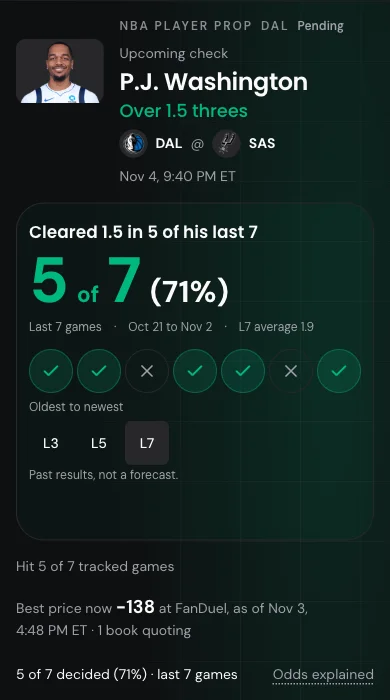
Open the image for full-size text. This is a dated snapshot, not an available offer. The quote was already about 54 minutes old at capture.
The comparison uses illustrative chatbot answers, not a test transcript. The Bet Check column reports this screen and its limits.
| Question | Unsourced AI answer | This Bet Check |
|---|---|---|
| Which bet and price? | A line or price with no current source | Over 1.5 threes; FanDuel -138; quote time and one-book limit |
| Which player and situation? | An old team or assumed normal workload | DAL at SAS; this capture doesn't verify injury status or workload |
| What does the hit rate cover? | A rate without results or dates | 5 of 7 (71%), October 21 to November 2, at the 1.5 line |
| What does the price require? | "71% means value" | The quoted -138 lets you calculate about 58.0% break-even; 71% remains historical |
Those seven displayed results were 2, 2, 0, 4, 2, 1 and 2 made threes. Five exceeded 1.5. You can audit that count without trusting an explanation.
You still can't subtract 58% from 71% and call the difference an edge. Seven past results don't establish next game's probability. The capture also doesn't supply a verified injury update or matchup statistic.
Bet Check and current-price comparison are free without an account. Missing markets, stale quotes or thin samples can limit a result. Confirm the match and sportsbook offer. The Bet Check user guide explains its boundaries.
When AI is genuinely useful
Give an assistant two dated public injury reports and ask what changed. Or paste a game log and ask it to count results above the exact line, then check the arithmetic.
It can also challenge a lean: "What evidence would make this over less convincing?" Don't let it invent an opposing case just to sound balanced.
After the game, compare the pregame assumptions with what happened. Did the player get the expected opportunities? Was the price you saved actually available? One win doesn't prove the research was good, just as one loss doesn't prove it was bad.
Judge performance claims by a defined record and method, not selected screenshots. WagerLens's public track record covers its published recommendations; it isn't a record of every Bet Check or proof that this workflow predicts winners.
FAQ
Can ChatGPT predict player props?
ChatGPT can generate a prediction, but that doesn't establish a reliable chance of winning. Use it to organise sources, explain statistics and question assumptions. Verify the exact line, available price, player status and game sample. A fluent explanation or historical hit rate isn't proof of a profitable forecast.
What's the best ChatGPT prompt for a player prop?
Use a prompt that names the player, sport, opponent, date, market, side, line, price, sportsbook and quote time. Supply sources, request facts separately from assumptions and unknowns, and ask for evidence against your lean. Require dated citations and missing-data disclosures. No prompt can guarantee correct research or a winning bet.
Why does ChatGPT give wrong betting lines?
Without a current source, an assistant can rely on older information or generate an incorrect number. Even web search can find yesterday's line or a different market. Open the cited page, match the player and exact selection, and confirm the quote's timestamp and availability directly at your sportsbook.
Is it safe to bet based on AI analysis?
AI analysis doesn't make a bet safe. Treat it as research input, not permission to wager. Check sources, price, sample size and unresolved news yourself. Pass when evidence is missing, set money and time limits before betting, and never raise your stake or chase losses because an answer sounds certain.
What should I check before trusting an AI hit rate?
Ask for hits and total games, the dates, the exact threshold and side, and the underlying results. Check how pushes and missing games were handled. Then ask whether the player's team, role or workload changed. A historical percentage describes that sample; it doesn't establish the probability of the next result.
How is a research tool different from a chatbot?
A purpose-built research tool can connect a matched market to tracked sportsbook quotes and game logs. A general chatbot may instead need you to supply those sources or enable search. Judge both by the visible evidence: exact line, dated price, sample and gaps. Neither the interface nor the label guarantees accuracy.
Keep the evidence with the bet
Paste the prop into Bet Check. It's free with no account. Read the matched line, sample window and quote timestamp, then use Save this check if you want to keep researching; the signed-out save action asks you to create an account.
Pass if a missing fact changes the decision. You don't owe an AI answer a bet.
Gamble responsibly · 1-800-GAMBLER. Set limits, never chase losses, and only bet money you can afford to lose.
See it live before you bet
Player props with best prices, hit rates with sample sizes, and a public track record.
- Every pick graded — wins and losses, no filters
- Hit rates for the exact line and recent windows
- Sportsbook price comparison on free Bet Checks
- Premium adds tracking, history and stats, and alerts
- Public track record with wins and losses