
How injuries change player props: researching the teammate-out bump
When a starter is ruled out, teammates may inherit his targets, carries or minutes, and sportsbooks can change their prop lines or odds. The "games without him" sample may cover only a few appearances, so treat it as a clue, not proof. Before betting, check the new line, the hit rate with its window stated, and the current price across books.
The useful question is whether the player's new role supports the number available now. The over you liked before the news may already be gone.
Why one injury changes several props
A missing starter leaves work for someone else. But the team doesn't have to distribute it evenly, or keep running the same offense.
A receiver's absence might mean more throws to the tight end and more running plays. Losing an NBA scorer might give one teammate extra minutes and another more shots. A quarterback injury can reduce passing production even when a receiver gets a larger share of the targets.
Separate three questions: who gains opportunities, what they can do with them, and what the sportsbook now asks them to produce.
The injured player's own market needs a separate rules check. FanDuel's prop guide says a non-participant's bet is typically voided, but tells bettors to check the specific market rules. Don't assume that covers every book, parlay or early exit.
NFL: where targets and carries go
When the WR1 or tight end is out
WR1 means the team's primary wide receiver. His targets, the passes intended for him, don't automatically become the second receiver's targets.
Check who stays on the field and runs pass routes. The slot receiver, tight end or running back might absorb short throws while an outside receiver faces more defensive attention. More snaps help establish a role; they don't guarantee more catches.
Use the NFL player hub to find the player, then compare his recent work with games when the missing teammate was absent.
When the lead running back is out
One backup might handle early-down carries while another plays passing downs. The back gaining the most rushing yards may not get the carries near the goal line.
Research the job needed for your market. Carries matter for rushing yards; pass routes and targets matter for receptions. A touchdown prop needs evidence about scoring opportunities, not just a new name atop the depth chart.
When the quarterback is out
A backup quarterback can change the whole calculation. The offense may throw less, complete fewer passes or use a different set of receivers.
A bigger share of a smaller passing game can still produce fewer yards. Check which quarterback played in earlier absences before treating those games as evidence for this week.
Offensive line and defensive injuries
Missing blockers can change protection and the running game. Defensive absences can change the opponent's coverage or personnel. Note the affected position and likely assignment, but don't invent a fixed yardage adjustment from an injury list.
NBA: minutes and usage
Minutes come first
Start with who actually plays more. A reserve listed at the injured player's position might gain fewer minutes than a starter who stays on the floor longer.
If a starting guard is out, two teammates might share the extra minutes. Check earlier rotations and current coaching comments. A player returning from his own injury may still have a minutes restriction.
Usage and shots
In basketball, usage describes how much of the offense a player finishes while on the court. The NBA's glossary defines usage percentage around team plays used, including shots, possession-ending free throws and turnovers. It isn't simply time spent holding the ball, and assists aren't part of that formula.
For points, inspect minutes and shot attempts before the scoring average. For assists, ask who initiates possessions and who is available to finish them. Rebounds depend on missed shots and lineup responsibilities. Those props need separate explanations.
Lineup shape
A coach may replace a missing big man with another guard. That changes assignments beyond the nominal replacement.
Rest days and back-to-backs make comparisons harder, particularly when several players sit together. Use the NBA player hub and today's NBA props to identify the current market, but confirm the actual rotation separately.
The "games without him" sample can be tiny
A split might contain only two to four games, sometimes spread across seasons.
Count games where the player you're researching actually appeared and the teammate didn't. Don't count his own missed games as zero production. If a teammate left midgame, keep that separate from a full absence.
Then ask what else changed. Were these last season's teammates? Was the quarterback different? Did overtime inflate minutes? Did a blowout remove the starters? More games help only when they answer the same question.
Opportunity counts help explain what happened. Targets and minutes tell you more about the role than a yardage total boosted by one long catch or points boosted by unusually accurate shooting. They're still uncertain future workloads, not promises.
There's no honest universal answer to "how many games without a player is enough?" Show X of Y (pct%), state the window, and explain the mismatches. Our hit-rate guide covers why the denominator matters as much as the percentage.
The line moves, so re-check the new number
Sportsbooks account for injuries when setting props. FanDuel describes injuries, player statistics, matchup data and betting trends as inputs. A move can affect the stat line, the payout odds or both; it doesn't prove a pricing mistake.
If an over moves from 44.5 to 64.5 receiving yards, count historical results above 64.5. The old rate answers a different question. For an unchanged set of results, raising an over's threshold cannot improve its hit rate.
Use Bet Check to inspect the matched player, market, side and exact line. Read whichever history and window are available. Don't assume its overall game sample is filtered to games without a particular teammate; verify those appearances separately.
Current price comparison across WagerLens's tracked US books is free. That doesn't mean every US sportsbook or every market is covered. Premium adds per-book price history and line movement, plus fair-odds and expected-value tools where available. Those are separate from comparing today's quotes.
Questionable isn't the same as out. Check the official NFL injury report and team inactives near kickoff. For basketball, use the latest league or team report and check again near tip-off for late scratches. If the player is active, reassess any minutes or workload restriction too.
Illustration: the role grew, but so did the line
Illustration: hypothetical players and values, not a real game.
An NFL team's WR1 is ruled out on Friday. You're researching the WR2's receiving yards. His line was 44.5 before the news; in this scenario, several books now offer 64.5.
You find three appearances without WR1 over the last two seasons. WR2 had 8, 10 and 9 targets, above his hypothetical usual workload of five. His receiving totals were 48, 73 and 88 yards.
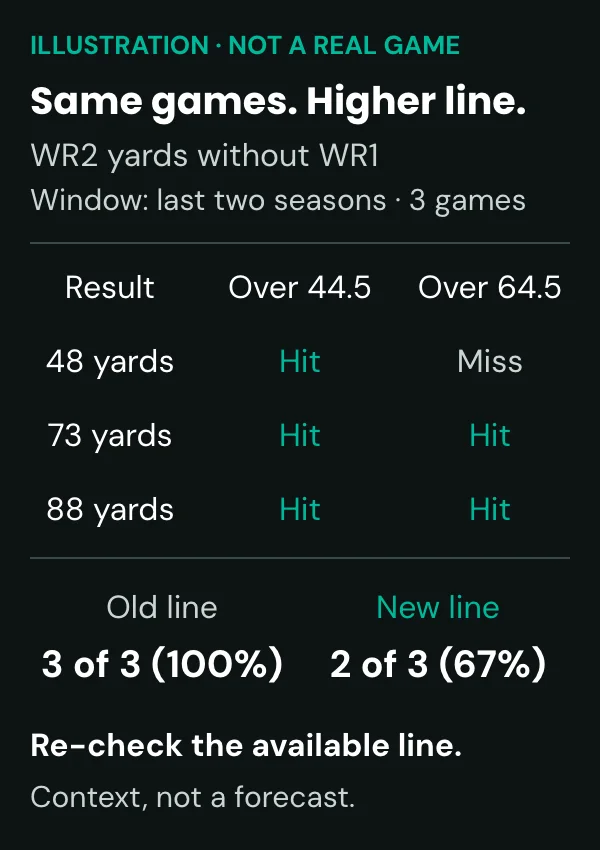
Tap the diagram to open it full size.
At the new line, that's 2 of 3 (67%), last two seasons, games without WR1, versus 3 of 3 (100%) at the old line in that same window. One game had a backup quarterback; another was a blowout. The workload increased, but the comparison is messy.
Now suppose two books quote over 64.5 at these illustrative prices:
| Price at the same 64.5 line | Win rate needed to break even |
|---|---|
| -110 | 52.4% |
| -130 | 56.5% |
At -130, you risk $130 to win $100, so the calculation is 130 divided by 230. Paying -130 instead of -110 raises the required win rate by about 4.1 percentage points. That arithmetic doesn't turn three past results into a forecast.
The conclusion: the role grew, the sample is three games, and the line already moved. This is research context, not a pick.
A five-step injury research routine
- Confirm who is out using an official report or team announcement. Check again before the game.
- Name the player whose role could grow and the stat that would show it: targets, carries, minutes or shot attempts. If the work is split, say so.
- Inspect the without-teammate appearances. Count them, state the window, and note other absences, quarterback changes and unusual game conditions.
- Recalculate the hit rate at the currently available line. Use the NFL research guide for the surrounding role, sample and matchup checks.
- Compare prices for the same market, side and line. Check quote timestamps and confirm the offer at the sportsbook. Decide whether to bet or pass.
If the prop is suspended, the quote is stale or the history doesn't cover a comparable role, leave the question open. Missing evidence isn't a reason to rush.
The line-shopping guide explains how price and quote freshness affect the decision. You can start with today's NFL props, but finding a market doesn't obligate you to bet it.
Matchup still matters
An increased workload still meets a defense. Position-level yards allowed describe a group of opposing players, not a prediction for the receiver you're researching. Check the stat, time window and number of games behind the comparison.
An injury can also change the spread and total, the market's view of the margin and combined scoring. That can change expected passing volume or fourth-quarter minutes. Bet Check doesn't provide a game-script or wind forecast; check those inputs separately.
Our public track record includes losses. Better research doesn't remove them, and passing is a valid result.
FAQ
How does a teammate being ruled out change a player prop?
Teammates can inherit targets, carries or minutes, changing both their expected workload and their prop lines. Several players may share the opportunity. Losing a quarterback or primary creator can also hurt the offense, so an increased role doesn't automatically mean more yards, points or a better bet.
Why is the games-without-him sample so unreliable?
It can contain only a few appearances, sometimes spread across different seasons. Opponents, quarterbacks, rotations and the player's own role may have changed. State the hits, total games and window, then inspect each game. No minimum game count makes an otherwise mismatched sample reliable.
What should I check after injury news before betting a prop?
Confirm the official status, identify who actually gains opportunities, and inspect comparable games without the teammate. Then check the hit rate at the current line with its sample and window stated. Compare prices for that same line across books, confirm the quote, and be willing to pass.
Do sportsbooks move player props after injury news?
Yes. Sportsbooks can change the stat line, the odds, or both when injury news changes the expected workload. A book may also suspend a market while updating it. Re-check the available number and price; a move doesn't establish its cause or prove either side is worth betting.
What happens to the injured player's own props?
Check the specific market's participation and parlay rules. A non-participant's prop is often voided; an injured player who appears and then leaves is a different case. Don't assume a refund.
Should I look at targets or yards when a teammate is out?
Opportunity first: targets, carries and minutes help explain a role. Then check production. A long catch or unusually accurate shooting can inflate yards or points without establishing a repeatable workload.
Does this work for NBA player props too?
Yes. Check minutes first, then shots and ballhandling. Several teammates may share the work, and points, assists and rebounds can change differently. Rest and lineup changes can weaken historical comparisons.
Run the new line through Bet Check. It's free with no account.
Gamble responsibly · 1-800-GAMBLER
See it live before you bet
NFL props with best prices, hit rates with sample sizes, and a public track record.
- Every pick graded — wins and losses, no filters
- Hit rates for the exact line and recent windows
- Sportsbook price comparison on free Bet Checks
- Premium adds tracking, history and stats, and alerts
- Public track record with wins and losses