
NFL rush + receiving yards props: how they work and how to research one
A rush + receiving yards prop adds a player's official rushing yards and receiving yards from the same game. Passing yards and return yards don't count. Unlike separate rushing and receiving bets, the combo tests one combined total. Research carries, targets, game conditions and results at the exact line before comparing the sportsbook price.
You'll also see it called rush + rec, combo yards or yards from scrimmage. The arithmetic is simple. Deciding how much weight to give the history takes more care.
Check a prop free, then confirm the matched market, side and line. A rushing-only result doesn't answer a combo-yards question.
What counts, and what doesn't
Illustrative example: 60 rushing yards plus 25 receiving yards equals 85 combo yards. Add a 30-yard kickoff return and the combo stays at 85.
Use the official net totals. Lost-yardage runs are already deducted from rushing yards; don't subtract them twice. The NFL's Guide for Statisticians explains that net-yardage calculation.
Read the threshold carefully:
- 90+ yards wins with 90 or more.
- Over 89.5 wins with 90 or more.
- Under 89.5 wins with 89 or fewer.
- Over 90 wins with 91 or more; exactly 90 normally pushes.
A push returns the stake on a standard single bet. Confirm your book's rules, including overtime, participation and stat corrections. A player who doesn't participate isn't automatically a winning under.
Fanatics' Tennessee house rules explicitly list scrimmage/rushing-and-receiving yards as a combined market. Your ticket's period and your sportsbook's jurisdiction-specific rules control settlement.
Combo line vs separate rushing and receiving lines
The combo has its own line and price. Don't assume you can calculate the posted number by adding two separate lines: each market prices a different outcome, and their thresholds needn't add neatly.
For an illustrative player with 60 rushing yards and 35 receiving yards, over 89.5 combo yards wins. Over 64.5 rushing yards loses, while over 24.5 receiving yards wins.
Two singles settle separately. A parlay combining those singles needs both legs to win. Neither is the same bet as the combo.
Receiving work can offset fewer rushing yards, but only if the player actually gets that work. A back who leaves the field on passing downs doesn't gain protection just because the market name includes receiving.
How to research rush + rec props in five checks
1. Check the player's workload
Start with carries and targets, meaning passes thrown toward the player. Then check snaps, routes and who handles passing downs. A target isn't a catch, and staying in to block isn't a receiving opportunity.
Look for injuries or a changing backfield split. The NFL player hub is a starting point; use team reports for details the page doesn't supply.
2. Recount results at the exact line
Add rushing and receiving yards within each game, then count hits at your threshold. Don't add separate rushing and receiving hit rates: those percentages don't tell you which combined totals cleared.
Write X of Y (pct%) with dates and a window. Compare a short streak with all comparable games rather than choosing whichever looks strongest. Our hit-rate guide explains why the denominator matters.
3. Check game script
Game script means how the score might change play calling. A team protecting a lead may run more; a trailing team may throw more. The spread and expected team points provide context, not a guarantee.
More passing helps this prop only if the back runs routes and draws targets. Don't assume every lost carry becomes a reception.
4. Check the opponent
Ask how this defense could change the player's opportunities. Rushing yards allowed and receiving yards allowed to backs measure different things.
Read those numbers alongside the offenses faced and the player's role. A season-long defensive ranking doesn't establish tonight's workload. The broader NFL prop research guide covers matchup and availability checks.
5. Compare the price for the same bet
Match player, game, period, side, threshold and settlement rules before comparing quotes. Under 89.5 and 90+ are opposite outcomes, not two prices for the same bet.
These are arithmetic examples, not current offers or estimates of a player's chance:
- At -110, you need 52.4% wins to break even.
- At -113, you need 53.1%.
- At -120, you need 54.5%.
- At -250, you need 71.4%.
For negative odds, divide their absolute value by that value plus 100. At -120, that's 120 / 220.
A lower yardage milestone can carry a much more expensive price. Use the odds converter; the vig calculator helps examine the sportsbook's margin. A historical hit rate isn't a forecast to plug straight into that comparison.
Worked examples: Bills at Rams, October 12, 2026
These are historical research examples, not picks or available offers. The Rams' game recap confirms the Monday-night matchup. The yardage below comes from WagerLens's public game logs, checked October 16.
Kyren Williams: 95+ combo yards
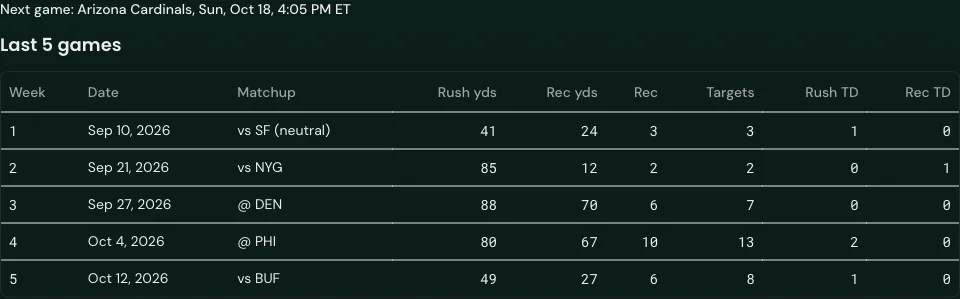
Before kickoff, Williams's game log showed combined totals of 65, 97, 158 and 147, oldest first, September 10 through October 4.
At 95+, that's 3 of 4 (75%) across those four games. Restrict the window to September 21 through October 4 and it's 3 of 3 (100%). Both counts describe their windows; only the first includes the opening-game miss.
On October 12, Williams recorded 49 rushing plus 27 receiving yards: 76 combined. That missed 95+, the same integer-yard outcome as over 94.5.
The screenshot below was captured October 16, after the game. Its fifth row wasn't available to a pregame researcher. Open either screenshot full size to read the labels.
James Cook: 90+ vs under 89.5
Cook's four pregame totals were 69, 139, 154 and 83, September 13 through October 4. At a 90+ research threshold, that's 2 of 4 (50%). Under 89.5 also hit in 2 of 4 (50%) over the same window.
His rushing/receiving splits were 57/12, 135/4, 154/0 and 75/8. Those receiving contributions didn't turn every sub-90 rushing game into a combo hit.
Cook then recorded 111 rushing plus 7 receiving yards on October 12: 118 combined. That cleared 90+ and missed under 89.5. These are threshold comparisons, not a reconstruction of a verified Cook sportsbook offer.
What the saved check preserves
The saved Williams over-94.5 check, captured October 16, shows the final 76 and the miss. Its headline uses 3 of 4 (75%); the saved-result text still cites the shorter 3-of-3 pregame window.
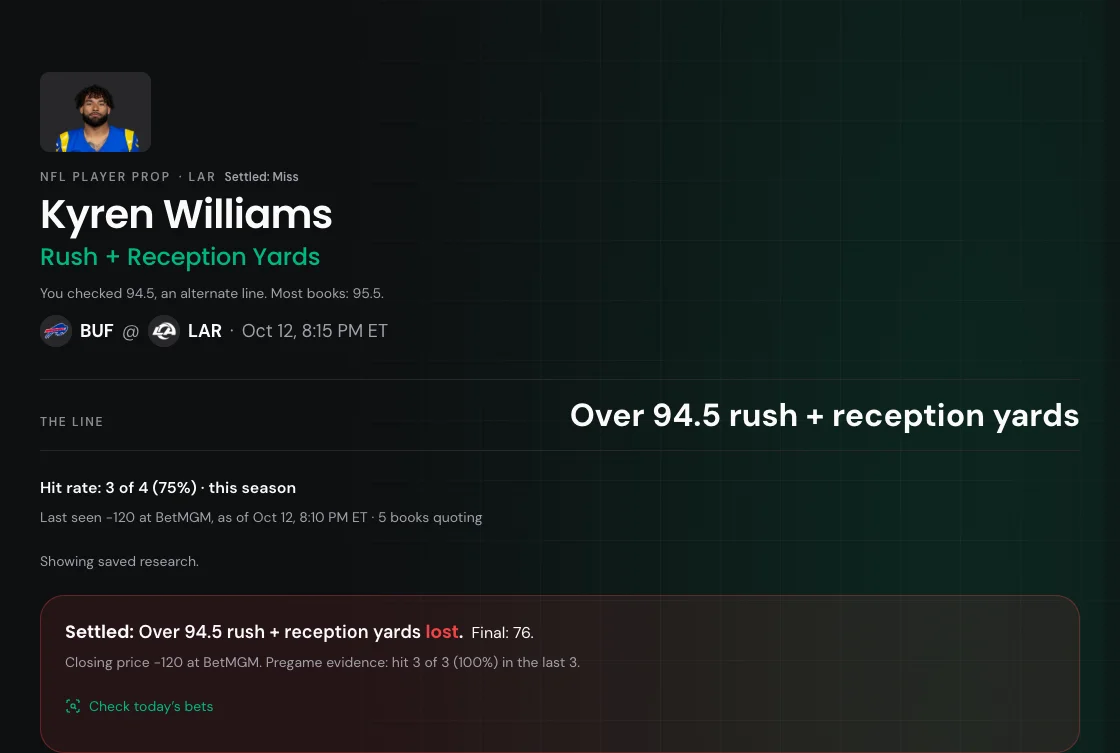
The last-seen BetMGM quote is -120, timestamped October 12 at 8:10 PM ET. That's a recorded historical quote, not an offer you can take now or proof it was the best closing price. Read the dates and underlying results when saved summaries use different windows.
Common mistakes
A 3-of-3 chip isn't proof of the next game's probability. Neither is a big average: one long play can lift it while several games remain below your line.
Don't mix return yards into the total, carry a hit rate across different thresholds, or treat two opposite sides as line-shopping alternatives. And don't silently include the game you're evaluating in its own pregame sample.
FAQ
What is a rush + receiving yards prop?
It adds a player's official rushing yards and receiving yards from the same game, then compares that total with the ticket's threshold. Passing and return yards don't count.
Do kick-return yards count?
No. Kickoff and punt returns aren't rushing or receiving yards. An all-purpose yards market is different; read the exact ticket and your sportsbook's rules.
Is the combo the same as adding the two singles?
No. The combo has its own line and price, and either type of yardage can contribute to its total. Two separate bets settle independently; a parlay of those bets needs both to win.
How do I read a 3-of-3 hit chip?
As 3 of 3 (100%) in the stated three-game window, not a forecast. Check the dates and any longer comparable window. A fourth game outside that streak may be a miss.
Is Bet Check free?
Yes, without an account. Bet Check and available sportsbook price comparison are free. Premium adds eligible bet tracking, history and stats, and alerts. Eligible accounts can start a 5-day trial; a card is required and Premium becomes paid unless canceled. Check the current pricing and terms before subscribing.
Keep researching
Browse today's NFL props or use Bijan Robinson's props page to practice the same checks. For a different market, read anytime touchdown props. Our public track record includes losses; research doesn't remove them.
Check a prop free. Confirm the exact match, sample window and quote timestamp, then verify availability at your sportsbook. Missing evidence is a reason to pause, not substitute a different market.
Bet Check is free without an account and shows the best tracked price when available. Sportsbook price comparison is free too. Premium adds tracking and deeper history; see current pricing and trial terms. WagerLens is a research tool, not a sportsbook.
Gamble responsibly. Bet only what you can afford to lose. Call 1-800-GAMBLER for support.
See it live before you bet
NFL props with best prices, hit rates with sample sizes, and a public track record.
- Every pick graded — wins and losses, no filters
- Hit rates for the exact line and recent windows
- Sportsbook price comparison on free Bet Checks
- Premium adds tracking, history and stats, and alerts
- Public track record with wins and losses