
Anytime Touchdown Props: How They Work and How to Research One
Anytime touchdown props, also called anytime TD props, are bets that a named player scores at least one qualifying touchdown in the specified game or period. One wins; extra touchdowns don't pay more. A quarterback's passing touchdown doesn't count for his own anytime TD bet. Rushing and receiving touchdowns do; sportsbook rules decide participation, return touchdowns and overtime.
The familiar name on the bet slip isn't the hard part. It's knowing what you're buying, how often the player gets scoring chances, and whether the price makes sense.
What counts as an anytime TD (and what doesn't)
A full-game anytime TD covers any qualifying touchdown. First scorer, last scorer and 2+ touchdowns are different markets.
Rushing and receiving TDs
A runner carrying the ball into the end zone counts. So does a receiver catching a touchdown pass. A one-yard score and a 70-yard score settle the same way.
Extra points and two-point conversions aren't touchdowns. Neither wins an anytime scorer bet. A touchdown overturned on review doesn't count either.
Passing TDs
Does a passing touchdown count for anytime TD? Not for the passer. If the quarterback throws a touchdown to his tight end, the tight end wins his anytime scorer bet. The quarterback hasn't scored one.
The quarterback needs his own qualifying touchdown, usually a rush, though a receiving TD can count too. "Over 1.5 passing touchdowns" measures a separate stat. Don't substitute passing-TD history when researching a quarterback's anytime TD.
Return and defensive TDs
Read the house rules rather than assuming every six-point play counts. FanDuel's Colorado rules count offense and special-teams scores for an individual scorer selection, but ordinarily assign a defensive touchdown to the team-defense selection, not that individual scorer bet.
A defensive-player market or rushing/receiving-only market can have different terms.
Overtime normally counts for a standard full-game NFL scorer market. A regulation-only, quarter or half market has a different scope.
Player doesn't play
What happens to an anytime TD bet if the player doesn't play? Non-participating players are commonly voided, but the participation test belongs to the book and market. FanDuel's Colorado scorer rules void a selection if the player plays no snaps.
An active roster spot isn't proof of participation. And leaving injured after participating doesn't automatically earn a refund. Check any separate injury-protection terms.
These distinctions follow FanDuel's Colorado house rules and Fanatics' Pennsylvania house rules, checked October 8, 2026. Your sportsbook's rules for your jurisdiction control settlement.
Reading anytime TD odds
Odds tell you the payout and the win rate required to break even, before accounting for your estimate's uncertainty. They don't tell you the player's true scoring probability.
| Illustrative American odds | Break-even win rate |
|---|---|
| +100 | 50.0% |
| +150 | 40.0% |
| +200 | 33.3% |
| -150 | 60.0% |
| -400 | 80.0% |
For positive odds, divide 100 by the odds plus 100. For negative odds, divide their absolute value by that value plus 100. Multiply by 100 for the percentage.
At +200, a $10 winning stake earns $20 profit, with the $10 stake returned. At -400, the same stake earns $2.50 profit. Those are arithmetic examples, not live offers.
Use the odds converter or understanding odds guide. Yes and no implied probabilities usually add to more than 100%; the vig calculator helps examine that margin.
How to research an anytime TD prop in 4 checks
Start with the exact player, market, side, game, price and book. Then ask:
- Who gets the goal-line work? Check carries inside the five-yard line, red-zone targets, snaps and routes. A back with fewer total carries can still own the short-yardage role. A quarterback's sneak usage can take those chances away. Confirm injuries and inactives near kickoff.
- How often did he score, in which games? Read the anytime TD hit rate as X of Y games, with dates and a window. Count games with at least one qualifying TD, not total touchdowns. Compare recent usage with the older games; a role change can make the longer sample less relevant.
- What could change the chances? Review the team total, spread, opponent and weather. A team expected to score more points may get more opportunities, but those points can come through someone else or field goals. Defensive TDs allowed are context, not a player-specific probability.
- What does the available price require? Compare identical markets and settlement rules across books. +150 and +200 require 40% and 33.3%, respectively. If news has shortened the odds, reassess at the new price. Don't treat an old quote as available.
The Saquon Barkley, Amon-Ra St. Brown and CeeDee Lamb props pages are research starting points, not recommendations.
WagerLens shows tracked results and prices. Don't assume it supplies every goal-line carry or route count; use team reports and usage data for anything missing. Our NFL prop research guide explains the broader process.
Over vs Under 0.5 TDs
For the same qualifying touchdown definition and game scope, over 0.5 means at least one touchdown. Under 0.5 means zero. There's no push at half a touchdown.
A "No" anytime TD selection usually describes the same outcome as under 0.5. Confirm the market: under 0.5 passing TDs is different from under 0.5 touchdowns scored.
The under isn't automatically good value because touchdowns are scarce. It can carry a steep negative price. At -250, for example, it needs about 71.4% wins to break even.
Non-participation rules apply to the under too. A void isn't a winning zero-TD result.
How often do anytime TD props actually hit?
There's no useful universal percentage. Players have different roles and prices, and a selected archive isn't a random sample of every market.
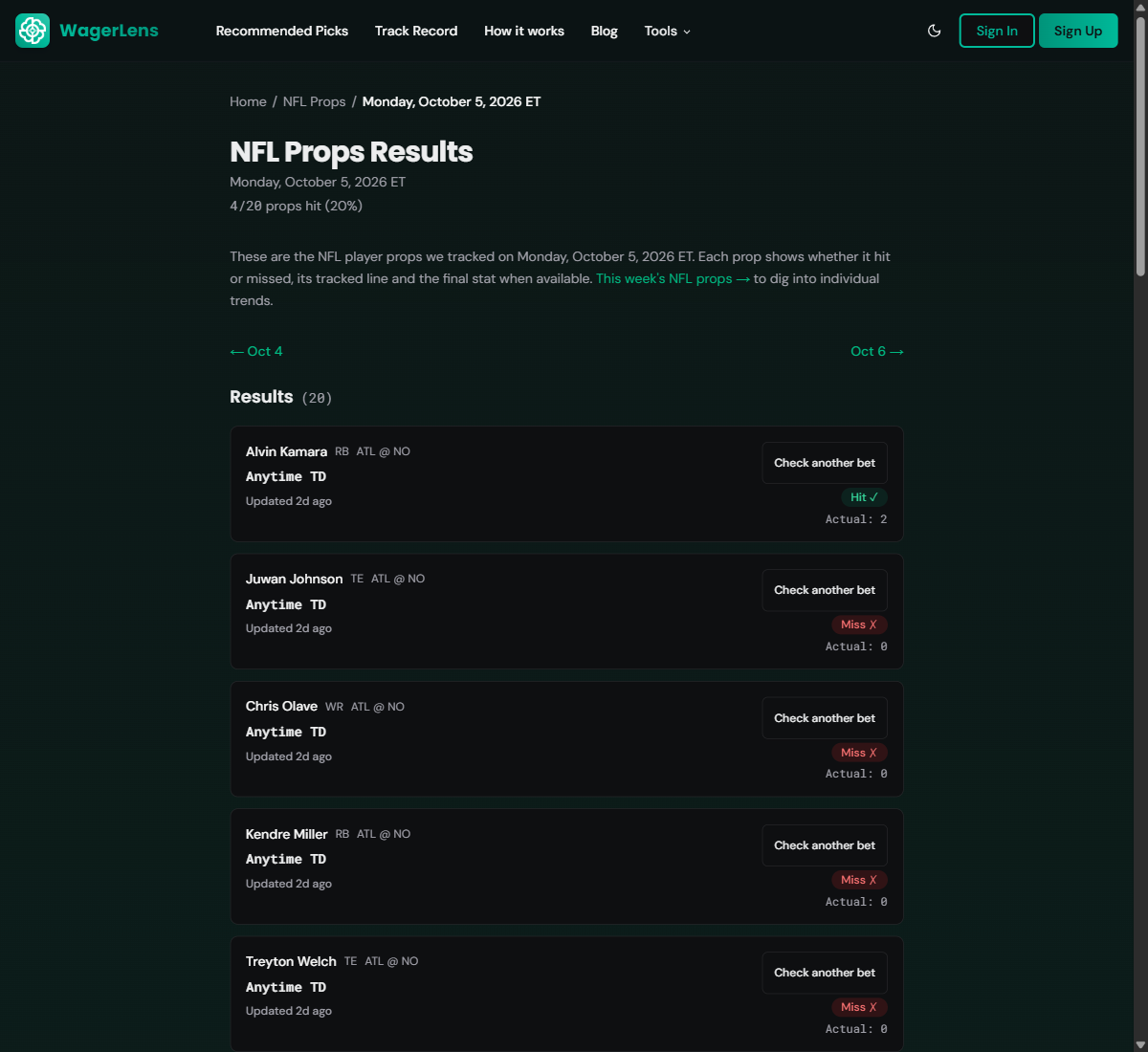
Here are WagerLens's public NFL archive results checked October 8, 2026:
| Archive date | Tracked anytime TD lines hit | Misses |
|---|---|---|
| September 27 | 10 of 20 (50%) | 10 |
| October 4 | 8 of 20 (40%) | 12 |
| October 5 | 4 of 20 (20%) | 16 |
| Combined | 22 of 60 (36.7%) | 38 |
The archive uses one graded record per player, market and game, preferring the latest stored graded over line, with an under fallback. Each date shows up to 20 records in stable record-ID order. That selection matters: these are tracked-line results, not a blanket scoring rate or a recommended betting card.
September 27 was rebuilt on September 30; its original published selection couldn't be recovered. The live sample now shows 10 of 20, replacing the older 8 of 20 figure in our NFL guide.
This sample spans only three dates, with players sharing games and some appearing on multiple dates. It can't establish an independent long-run rate or profitability without the prices. It does show why misses belong beside hits.
Worked example: a scoring streak at an expensive price
Example, not a pick. The saved Jahmyr Gibbs anytime TD check showed 4 of 4 scoring games (100%), September 13 through October 4, when captured October 8, 2026. The game results were 2, 1, 3 and 1 touchdowns, oldest to newest.
That's seven touchdowns but four anytime TD hits. Three touchdowns in one game still produce one winning game in the hit-rate calculation.
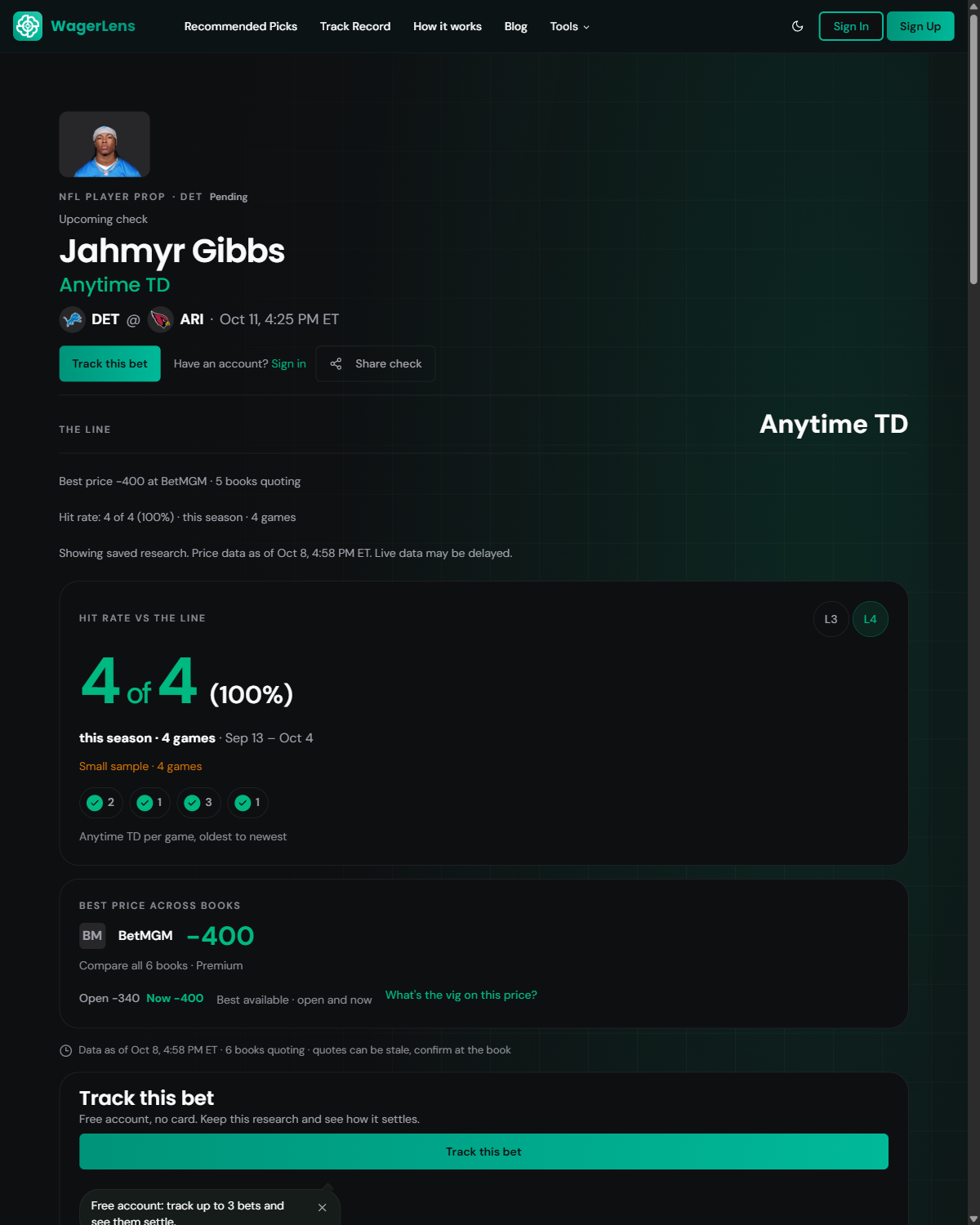
The -400 BetMGM quote was dated October 8, 4:58 PM ET. It needs 80% wins to break even. Four scoring games don't prove an 80% chance next game. Check usage and availability, then confirm at the book.
Common mistakes
Counting a quarterback's passing TDs is a settlement mistake. Counting seven TDs as seven hits in four games is a sample mistake. Neither gets fixed by a bigger payout.
A popular player can still be overpriced. A 4-of-4 run is a small sample, and a player who missed last week isn't "due."
Every parlay leg must win. Same-game legs can be correlated; don't simply multiply their individual probabilities. The parlay calculator explains payouts, not a TD parlay's value.
Keep researching
Read how to interpret prop hit rates, use the sports betting glossary, or browse today's NFL props. Our public track record isn't a guarantee for this market.
Have an anytime TD prop in mind? Check it free, then confirm the player, side, sample window and price timestamp. Don't substitute a different market just to get a result.
WagerLens is a research tool, not a sportsbook. No touchdown prop is a sure thing. Bet only what you can afford to lose, and don't chase misses. For support in the U.S., call the National Problem Gambling Helpline at 1-800-522-4700.
Frequently asked questions
What is an anytime TD prop?
An anytime touchdown prop is a bet that a named player scores at least one qualifying touchdown in the specified game or period. One wins; extra touchdowns don't increase the payout.
Does a passing touchdown count for an anytime TD?
Not for the quarterback who throws it. The receiver gets the touchdown for a standard anytime scorer bet. A quarterback can win by rushing for or catching a touchdown.
Does overtime count?
Normally, in standard full-game NFL scorer markets. Not in regulation-only or specified-quarter markets. Check the market name and your sportsbook's rules.
What happens if my player doesn't play?
Non-participating players are commonly voided, but rules differ. FanDuel's Colorado scorer rules void players who play no snaps. An injury after participation doesn't automatically void a bet.
How often do anytime TD props hit?
There's no universal rate. WagerLens's selected archive lines for September 27, October 4 and October 5, 2026 showed 22 of 60 hits (36.7%), checked October 8. That's a selected results sample, not a forecast or profitability figure.
Is Bet Check free?
Yes, without an account. Bet Check shows supported prop evidence and the best tracked price when available. Read sample sizes and timestamps, then confirm at the sportsbook.
See it live before you bet
NFL props with best prices, hit rates with sample sizes, and a public track record.
- Every pick graded — wins and losses, no filters
- Hit rates for the exact line and recent windows
- Sportsbook price comparison on free Bet Checks
- Premium adds tracking, history and stats, and alerts
- Public track record with wins and losses