
A kicker prop is a bet on where his team's drives end. Start with the implied team total from the spread and total. Use both teams' red-zone touchdown rates to assess the split between extra points and field goals. Then check the kicker, weather, fourth-down decisions, settlement rules and price.
Research chances before averages. This guide builds on the NFL player props research checks.
The three kicker markets
| Market | What counts | Example |
|---|---|---|
| Kicking points | Three per field goal made, one per extra point made | Two field goals plus three extra points = 9 |
| Field goals made | Successful field goals, regardless of distance | Over 1.5 needs at least 2 |
| Extra points made | Successful kicks after touchdowns, also called PATs | Over 2.5 needs at least 3 |
The NFL scoring rules distinguish three-point field goals from one-point try kicks. Don't import fantasy bonuses for long kicks into a kicking points prop. Two-point conversions don't count.
Step 1: Start from the implied team total
The implied team total is the team's expected score suggested by the game total and spread. A total of 47 with a three-point favorite implies about 25 for the favorite and 22 for the underdog: halve the total, then add or subtract half the spread.
That's an estimate, not a promised score. The sportsbook's separate team-total market may differ.
More expected scoring creates possible kicking opportunities, but doesn't guarantee more field goals. A team scoring four touchdowns can give its kicker four points; a team scoring three field goals gives him nine.
Step 2: Check the red-zone split
The red zone is the area inside the opponent's 20-yard line. Red-zone touchdown rate measures how often trips there end in touchdowns. Check the offense's rate and the opponent's red-zone touchdown rate allowed, using the same season or window.
Stalled drives can create field-goal chances; touchdowns create possible extra points.
Don't treat every failed red-zone trip as a field goal. Turnovers, missed kicks and failed fourth downs also end drives. Field goals can come from outside the red zone, while touchdowns can come from long plays or defense. Read these rates as context, not a formula that converts team points into kicker points.
Step 3: Research the kicker himself
Separate attempts from makes. Review accuracy by distance, especially 40–49 and 50+ yards, with makes, attempts and the window together. A season-long percentage mixes easy and difficult kicks; one long make doesn't establish reliable range.
For extra points, examine extra-point attempts and accuracy directly. The NFL's try-kick snap is from the 15-yard line, so these aren't automatic short kicks.
Confirm health and who has the job. For replacements, don't substitute the previous kicker's game log. See props with little history.
Step 4: Check weather and venue
Check wind speed, gusts, direction, temperature and rain near kickoff, plus roof status. Cold can reduce carry; wind can affect accuracy and the distances a coach will attempt. Wet conditions can complicate the snap and hold.
RotoWire's kicker model explicitly adjusts field-goal projections for wind. Its chosen adjustments aren't universal thresholds or proof that a weather-based bet is good value.
A closed roof removes direct exposure to outdoor wind and precipitation. An open retractable roof doesn't. Conditions also affect the offense, so bad weather isn't automatically good for field goals just because touchdowns become harder.
Step 5: Check fourth-down decisions
A drive in kicking range still needs the coach to choose a kick. Review fourth-down attempts in comparable field position and distance, rather than using an overall aggression label.
Score matters. A trailing team may need a touchdown instead of three points, and two-point tries replace extra-point attempts. Check those decisions alongside the spread. Kicker legs and team totals can also be related in a same-game parlay; don't assume they're independent.
How kicker bets settle
Read your book's rules. Football scoring and sportsbook settlement aren't interchangeable.
For made-kick markets, misses and blocks that don't score add nothing. If a penalty erases a kick, use the official result after enforcement, not the original television play. Two-point tries add no kicking points.
Check participation requirements, overtime, cancellations and stat corrections separately. Don't assume “no attempts” means a void: playing without getting a chance to kick differs from not playing at all. WagerLens grades historical results on raw stats; it doesn't store your book's settlement rules or determine whether your ticket is void.
Think in whole numbers, not averages
A field goals made prop at 1.5 asks whether the kicker makes at least two. An average of 1.8 doesn't answer that. Count qualifying games and keep the window attached: “2+ in 4 of 6 games (67%), this season” would describe a hypothetical sample, not a forecast.
At a whole-number line, an equal result may push under the book's rules. Keep pushes separate from wins and losses. See how to read prop hit rates.
Illustration: A kicking points line
This is hypothetical, not a real matchup or pick. The line is 7.5, the game total is 47, and the kicker's team is favored by three, implying about 25 team points.
Three touchdowns with three extra points and one field goal produce 24 team points but only six kicking points. Two touchdowns with two extra points and three field goals produce 23 team points and 11 kicking points. Both team scores sit near 25; the kicker outcomes land on opposite sides of 7.5.
Now ask whether the red-zone evidence, kicker's range, forecast and coach's decisions support either scoring path. Compare the exact line across books using the line-shopping guide. At -110, the win rate needed to break even is about 52.4%; historical frequency alone doesn't establish that chance.
Reading a kicker check on Bet Check
Bet Check supports field goals made, kicking points and extra points made.
The Brandon Aubrey over 7.5 kicking points check showed 3 of 6 tracked games (50%), September 13–October 18, 2026, when captured October 26. That's dated history, not a recommendation or current offer. Open the image for full size.
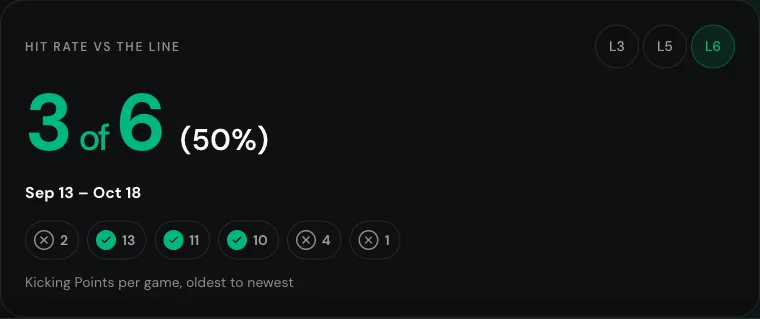
Read available attempt data and game weather, then check quote timestamps. Missing weather isn't calm weather; an old price isn't an available offer. Look up team totals and team red-zone rates elsewhere. NFL player pages provide another route to game logs.
FAQ
How are kicking points calculated?
Kicking points equal three times field goals made plus extra points made. Two field goals and three extra points produce nine kicking points. Missed kicks add nothing. Unlike some fantasy scoring systems, longer field goals don't earn bonus kicking points. Check that your sportsbook's market uses this definition.
What's the best way to research a kicker prop?
Start with the team's implied points from the spread and total. Check how often its red-zone trips become touchdowns, plus the opponent's touchdown rate allowed. Then review the kicker's distance splits, weather, fourth-down decisions and settlement rules. Finish with the exact line, historical sample and available price.
How does weather affect kicker props?
Wind can affect accuracy and usable range; cold can reduce carry, and rain can complicate the snap and hold. Coaches may decline long attempts when conditions worsen. Check kickoff conditions and roof status. A closed roof removes direct outdoor exposure, but weather alone doesn't establish a profitable over or under.
Does a two-point conversion count toward kicking points?
No. A two-point conversion is a run or pass instead of an extra-point kick, so it adds no kicking points or extra points made. A touchdown followed by a successful two-point try gives the team eight points, but gives its kicker zero points from that scoring sequence.
Why look at how often a kicker made 2+ field goals instead of his average?
Over 1.5 field goals needs at least two makes. Counting games with two or more directly matches that threshold; an average can hide several one-field-goal games behind one big afternoon. Keep the number of games and time window beside the percentage. Historical frequency isn't the probability of the next game.
Check the line before you bet
Check a kicker prop free, or browse today's NFL props. Confirm the line, sample and available price before deciding.
Gamble responsibly · 1-800-GAMBLER
See it live before you bet
NFL props with best prices, hit rates with sample sizes, and a public track record.
- Every pick graded — wins and losses, no filters
- Hit rates for the exact line and recent windows
- Sportsbook price comparison on free Bet Checks
- Premium adds tracking, history and stats, and alerts
- Public track record with wins and losses