
Same-Game Parlays and Correlated Props: What the Correlation Tax Costs You
Same-game parlay correlation means the legs are connected: a quarterback's big passing day can help his receiver clear a yardage line. Sportsbooks account for that connection with a shorter payout and also build in margin. Check each leg's price and evidence before combining them; multiplied odds are a comparison point, not proof of a fair SGP price.
A same-game parlay, or SGP, combines selections from one game into one ticket. Each selection is a leg. Subject to the book's void and push rules, every leg must win.
What correlation means in a same-game parlay
Correlation asks whether one leg winning changes the chance of another winning. With positive correlation, they tend to win together more often than if they were unrelated. Negative correlation means one winning makes the other less likely.
A quarterback's passing yards include yards gained by his receivers. His passing over and a teammate's receiving over therefore share part of the same production. But the quarterback could spread the ball around while that receiver falls short.
These are possible relationships, not measured correlation estimates:
| Legs from one game | Possible relationship |
|---|---|
| NFL quarterback passing over + his top receiver's receiving over | Positive: the same completions help both. |
| NFL favorite covers the spread + its running back's rushing over | Positive if a lead brings more carries; not guaranteed. |
| NBA guard assists over + teammate points over | Positive when the guard creates that teammate's baskets. |
| MLB hitter home run + his team runs over | Positive: the home run contributes to team runs. |
| Game total under + a receiver's high yardage over | Potentially negative, though yards don't always produce points. |
An NFL game over and both quarterbacks' passing overs can share a high-scoring script. A large underdog covering and the favorite's running back clearing a rushing line might pull against each other if the favorite gets fewer late carries.
The lines matter. A receiver can have a huge game in a low-scoring loss. An NBA blowout can reduce a starter's minutes. Don't assign a fixed relationship from the player names alone.
Different-game legs are often treated as independent, meaning one result doesn't change the other's chance. Multiplying probabilities works under that assumption, not merely because the games have different start times.
Why books shorten correlated parlays
Suppose two hypothetical outcomes each have a true 50% chance. If independent, both win 25% of the time. Fair odds, with no bookmaker margin, would be +300: $30 profit on a $10 stake.
Now suppose positive correlation raises their joint chance, the chance both win, to 30%. Fair odds become about +233. A shorter payout is mathematically appropriate. The connection made the combined outcome more likely; it didn't create a free advantage.
What the "correlation tax" actually means
"Correlation tax" is an informal name for the gap between multiplied single-leg odds and the offered SGP payout. It isn't an itemized fee. Part reflects the relationship between the legs; sportsbook pricing and margin also affect it.
Margin is the cushion a sportsbook builds into prices. Flutter's 2024 annual report describes same-game parlays as higher-margin bet types. That's a dated operator disclosure, not evidence that every SGP carries one universal percentage.
The observed payout gap can't separate those ingredients. Single-leg odds already contain margin, and their implied percentages aren't necessarily the true probabilities.
Books can also reject combinations. FanDuel's Indiana house rules prohibit related selections unless explicitly offered, such as through an SGP. A blocked combination isn't evidence you've found a pricing mistake.
How to check whether an SGP price is fair
You can compare prices without pretending to know the exact chance of the whole ticket.
1. Find each leg's price at the exact line
Use Bet Check to research each leg and compare tracked US sportsbook prices. It's free without an account. Confirm the player, market, side and line, then verify the quote at the book. A stale price isn't an available offer.
Over 64.5 receiving yards isn't the same bet as over 69.5. Keep the thresholds identical throughout the comparison.
2. Multiply decimal odds as an independence benchmark
Decimal odds include your returned stake. For negative American odds, divide 100 by the odds' absolute value, then add 1:
- -115 becomes 1 + 100 / 115 = 1.869565.
- -110 becomes 1 + 100 / 110 = 1.909091.
- Multiply the unrounded values: 1.869565... x 1.909091... = 3.569170.
Convert back by subtracting 1 and multiplying by 100. The result is approximately +257.
Keep extra decimal places until the end. Multiplying rounded 1.87 and 1.91 is fine for a rough check, but isn't the exact calculation.
3. Compare what the same stake would return
| Hypothetical $10 ticket | Profit if both legs win |
|---|---|
| Multiplied single-leg benchmark, about +257 | $25.69 |
| Offered SGP at +210 | $21.00 |
| Difference | $4.69 |
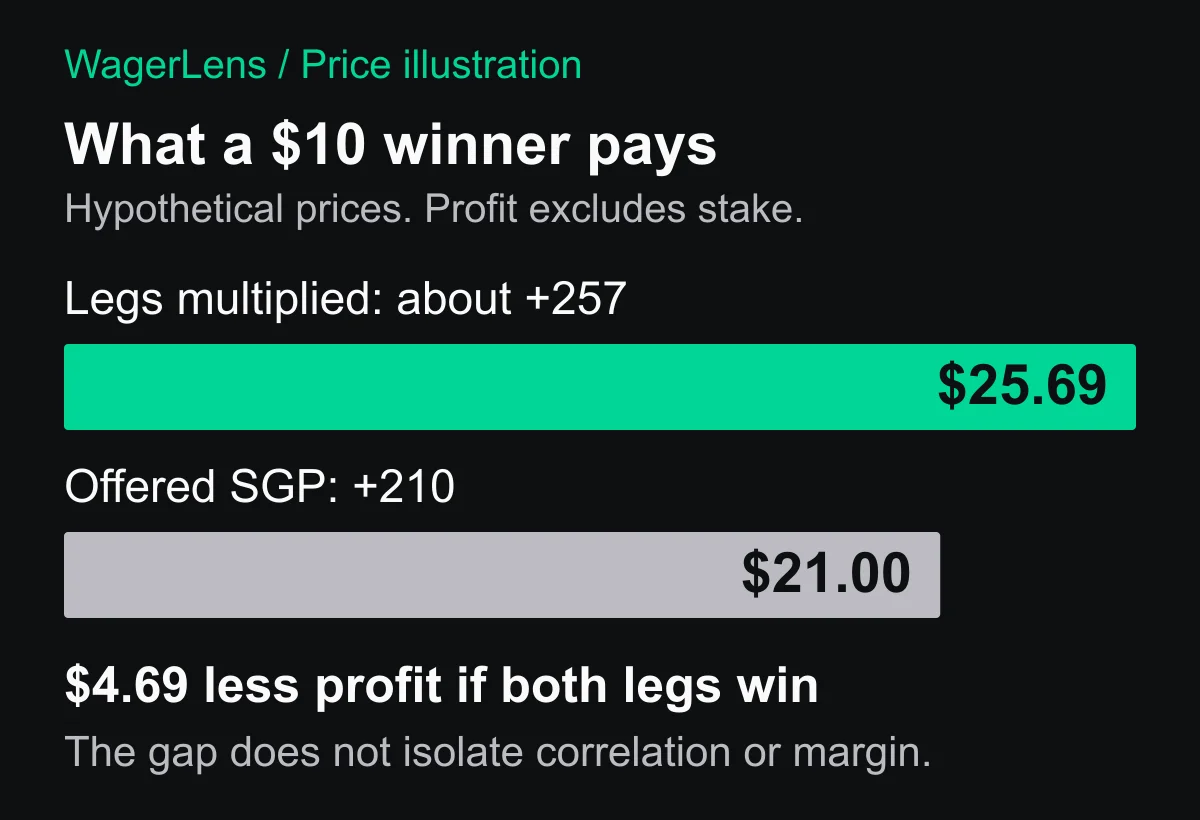
Open the illustration to view it full size. The $4.69 is a reduction in profit if the ticket wins, not an expected loss or a measured house edge.
At +210, the ticket needs to win about 32.3% of the time to break even, assuming no pushes or voids. That's price math, not a prediction. We haven't established whether these legs win together that often.
The best single-leg quotes may come from different books. You can't combine them into one cross-book SGP. Compare the chosen book's own single-leg prices too, so you don't mistake a line-shopping difference for a correlation adjustment.
4. Know what the comparison can't prove
A smaller payout is expected for positively correlated legs. Negative correlation would justify a longer fair payout than independence, all else equal. Neither direction tells you whether the book's actual price is fair.
If legs appear barely related but the payout drops sharply, compare the identical SGP elsewhere or pass. You haven't proved the gap is "mostly margin" without a credible joint-probability estimate. A convincing game story isn't that estimate.
Premium fair odds and expected value, the estimated average gain or loss at a price, can help assess eligible individual checks. They don't price the combined SGP. WagerLens doesn't calculate same-game correlation or certify a ticket's fair payout.
Thin samples don't become stronger when stacked
Suppose the illustrative receiver cleared 64.5 yards in 6 of 9 games (67%), this season. That describes nine past appearances at the stated threshold. It doesn't establish a 67% chance today, particularly after a role or quarterback change.
A quarterback's separate hit rate doesn't tell you how often both players cleared their lines in the same games. You need the overlapping results to investigate that relationship, and even those may cover too few comparable games.
Four legs each showing 4 of 5 (80%), last five games, aren't four proven good bets. Each sample is thin. You also need every leg to win, and shared conditions can affect several at once.
Don't multiply historical hit rates and call the result the SGP's win probability. Read how to read prop hit rates for exact-line comparisons, windows and sample sizes.
Scratches, voids and pushes in SGPs
A scratch is a player withdrawn before playing. A push is a tied betting result, such as exactly 250 passing yards against a line of 250. Neither automatically tells you how the whole SGP settles.
FanDuel's Indiana rules say void selections are removed and remaining parlay odds recalculated, including SGPs. Fanatics' Pennsylvania rules also describe adjusted odds after a void selection, with sport-specific provisions. These rules were checked October 21, 2026; your current local rules control.
Don't simply divide out the removed leg's decimal odds. Its relationship with the remaining legs may have affected the original price.
Check participation requirements, injury-exit treatment, postponements and push rules before betting. A player who appears and leaves hurt is different from a non-participant. Read how injuries change player props when news changes the legs you researched.
A five-step SGP routine on WagerLens
- Type each leg into Bet Check in plain words. Confirm the matched player, line and market.
- Read each leg's recent evidence with hits, games and window stated. Compare current prices; confirm stale or changed quotes at the sportsbook.
- Describe how the legs relate: positive, negative or apparently unrelated. Write down what could break that story.
- Compare the SGP with the multiplied benchmark and identical tickets at other books. Include settlement rules, not just the headline payout.
- Choose the SGP, fewer legs, singles or no bet. Passing is a valid result when the price or evidence is unclear.
Bet Check researches legs individually. A multi-leg result isn't an endorsement of the combination, and WagerLens doesn't take bets.
Are same-game parlays worth it?
Treat an SGP as entertainment unless you have credible evidence that the offered payout exceeds its risk. Seeing a connection between legs isn't enough: the sportsbook can see it too.
Singles are easier to evaluate because you don't need to estimate the whole ticket's joint chance. They still can be bad bets at the wrong price. Start with sportsbook prices and line shopping.
The vig calculator helps examine margin in a two-sided market. It doesn't reveal an SGP's hidden correlation assumptions or turn its payout into fair odds.
If you play, keep stakes small within a budget you can afford to lose. Don't add another leg to rescue an unappealing payout or increase the next stake to recover a loss.
FAQ
What does correlation mean in a same-game parlay?
Correlation means one leg winning changes how likely another leg is to win. A quarterback's passing over and his receiver's receiving over can benefit from the same completions. Positive correlation helps legs win together; negative correlation makes that harder. Neither relationship proves the offered payout is good.
Why do sportsbooks pay less on correlated same-game parlays?
With positive correlation, all the legs can win together more often than multiplying their separate probabilities suggests. A higher chance calls for a shorter fair payout. Sportsbooks also price in margin. The difference from multiplied single-leg odds doesn't tell you exactly how much is correlation versus margin.
What is the correlation tax?
It's an informal label for the payout reduction from multiplied single-leg odds to the offered same-game parlay price. Part can be a fair adjustment for positive correlation; pricing differences and margin also matter. It isn't a separate fee or a reliable measurement of the sportsbook's house edge.
Are same-game parlays worth it?
They can be entertainment if you accept the risk and payout, but an obvious connection between legs isn't a profit strategy. Sportsbooks account for correlation and can build in substantial margin. Check the exact ticket, keep any stake within an affordable entertainment budget, and don't chase a loss.
How do I check whether an SGP price is fair?
Find each leg's current price at the exact line, multiply decimal odds as an independence benchmark, and compare identical SGP tickets across books. That comparison alone can't establish fairness. You also need a credible estimate of how often all legs win together, accounting for correlation and uncertainty.
What happens if a player in my SGP doesn't play?
Read your sportsbook's rules for that sport, market and jurisdiction. A voided leg can lead to a recalculated payout on the remaining selections; an entire ticket can also be void under applicable rules. A player appearing and then leaving injured is different from never participating. Don't assume a refund.
Check the legs before the ticket
Check every leg before you combine them. Run each one through Bet Check; it's free with no account. Read the sample, confirm the price, and remember that a shorter SGP payout can be justified without being a good deal.
Gamble responsibly · 1-800-GAMBLER
See it live before you bet
Player props with best prices, hit rates with sample sizes, and a public track record.
- Every pick graded — wins and losses, no filters
- Hit rates for the exact line and recent windows
- Sportsbook price comparison on free Bet Checks
- Premium adds tracking, history and stats, and alerts
- Public track record with wins and losses