
How rest and schedule affect player props: back-to-backs, short weeks and byes
For a player prop, check who will play and for how long before assuming fatigue means lower production. Back-to-backs and crowded schedules can change availability, minutes and teammates' roles. Confirm the status close to game time, re-check the current line, and compare prices. The calendar alone isn't a reason to bet an under.
This applies differently across sports. An NBA back-to-back means games on consecutive nights. An NFL short week might mean playing Thursday after Sunday; a bye means a week without a game.
The short answer: availability beats a fatigue assumption
There's evidence against automatically lowering a playing NBA star's scoring expectation. ParlayTools' five-season analysis compared players with their own other appearances in the same season, covering the 2021-22 through 2025-26 regular seasons.
Among players averaging at least 20 points, it reported 2,403 second-night appearances across 237 player-seasons. The differences in points and minutes were both 0.0 at its reported precision. Those scorers missed 24.6% of second nights versus 16.7% of other games.
Those are ParlayTools' findings, not a WagerLens backtest. Its missed-game count includes injuries and coaching decisions as well as rest. The comparison also selects players who actually appeared; it doesn't establish how an unavailable player would have performed, or prove that fatigue never matters.
Use that distinction in your research: investigate whether the player will play, then his expected workload. Don't treat a schedule label as a fixed points deduction. And don't assume the sportsbook overlooked a public schedule.
NBA back-to-backs and three games in four nights
A three-in-four stretch means three games across four calendar days. It can include a back-to-back, but the third game doesn't have to follow a game the night before.
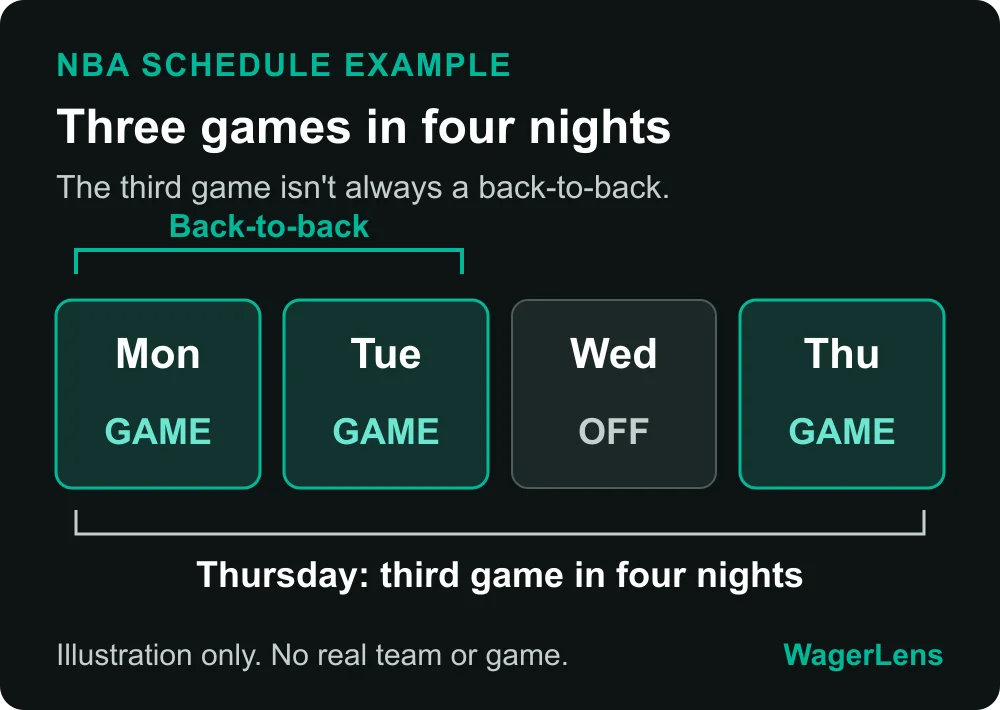
Tuesday is the second night of a back-to-back; Thursday is the third game in four nights. This is an illustration, not a real team's schedule. Tap the illustration to open it full size.
Who sits, and who plays fewer minutes
Check the individual report, especially for a veteran or someone returning from injury. Age and schedule alone don't tell you whether a player will rest.
Second-night news can arrive later. The NBA's published 2025-26 reporting policy set a 1 p.m. local game-day reporting deadline for the second game of a back-to-back, rather than the usual previous-day deadline. Reports update throughout the day. Use the latest league and team information near tip-off.
Being active doesn't promise a normal workload. Look for a reported minutes restriction. Points, rebounds and assists all need time on the floor; a points-plus-rebounds-plus-assists prop, often called PRA, still depends on those opportunities.
Who absorbs the minutes
If a starter sits, the replacement at his position doesn't necessarily inherit everything. Another starter might handle the ball more while two reserves share the extra minutes.
Name the likely beneficiary and the relevant stat. More shots can matter for points; more time initiating possessions can matter for assists. The injury and teammate-out guide explains why a bigger role and a better-priced bet are separate questions.
Travel and rest advantage
An overnight trip, a time-zone change or a rested opponent adds context. None gives you a defensible universal deduction from tonight's points line. Check both teams' schedules, but don't count travel as a second penalty if your existing projection already accounts for it.
NFL short weeks and byes
Thursday after Sunday
A short turnaround leaves fewer days for recovery and preparation. That doesn't tell you how many receiving yards to subtract or make every Thursday prop an under.
Watch the reporting calendar too. NFL Football Operations lists Monday-through-Wednesday practice reports for Thursday games, with the game-status report on Wednesday. Don't wait for a Friday update that belongs to a Sunday-game routine.
A limited practice means limited participation in that session, not a guaranteed snap limit in the game. Read the official injury report, then confirm game-day inactives. For a receiver, ask whether he can run his usual routes and whether the quarterback and other receivers are available.
After a bye
A bye gives a team extra time between games. It doesn't guarantee more catches, carries or touchdowns for a particular player.
Someone returning from injury may regain work, reducing a teammate's opportunities. Or the returning player may still be restricted. Check the current role rather than carrying the pre-bye lineup forward unchanged.
Long rest against a short-week opponent is worth noting, but it isn't a player-level forecast. The NFL prop research guide covers the surrounding role, matchup and sample checks.
How sportsbooks treat a player who rests
If a player doesn't participate, his prop is usually voided: the bet is cancelled and the stake returned. FanDuel's prop guide describes that typical outcome while directing readers to the specific market rules.
A brief appearance is different. For example, FanDuel's Massachusetts house rules filed July 30, 2026 say basketball player-performance bets stand once the player takes the court, irrespective of playing time; no participation voids them. That's a dated, jurisdiction-specific example, not a rule for every book or market.
Before betting, check the participation requirement, any early-exit exception and the parlay rules. A same-game parlay combines selections from one game; a scratched player can affect the remaining ticket and payout differently under different rules.
Don't assume an under wins because a resting player recorded zero. A void is neither an over loss nor an under win.
The hit-rate trap: tiny schedule splits
A player's back-to-back or Thursday sample can be much smaller than his full-season history. Filtering again for road games or a particular opponent makes it thinner.
Write the result as X of Y (pct%), with the line and window. Count appearances separately from missed games. Check what else changed: teammates, opponent, a minutes restriction or a blowout that emptied the bench.
The hit-rate guide explains why past results aren't the probability of tonight's outcome. An overall recent hit rate also isn't a back-to-back split unless those games were specifically selected.
Illustration: a veteran guard on the second night
Illustration: hypothetical player and values, not a real game.
You're researching a veteran guard over 22.5 points after a road game the night before. He's listed probable late in the morning. That isn't confirmation of a normal workload.
Your hypothetical research finds he cleared 22.5 in 3 of 5 appearances (60%), on back-to-backs over the last two seasons. One game was a blowout. Those five appearances can't establish a reliable chance of clearing tonight's line.
If he sits, check the book's void rules and research the backup separately. If he plays, confirm any reported restriction. Suppose the line has moved to 24.5: the 22.5 hit rate no longer answers the current question.
Finally, compare prices at the same line. At hypothetical odds of -110, you risk $110 to win $100 and need 52.4% wins to break even; at -130, you need 56.5%. Neither rate is a prediction. The schedule adds questions, and the price still matters.
Where to see rest on WagerLens
Type the bet in plain words into Bet Check. Confirm the matched player, market and line, then read the available evidence and sample.
For supported NFL checks with schedule data, the Matchup section's Rest tile surfaces a gap of at least two days, a short week or extended rest such as after a bye. When rest differs, it names the team with extra rest and shows both counts. A normal seven-versus-seven comparison is omitted.
These are team schedule counts, not the player's days since his last appearance. The tile isn't an NBA back-to-back alert, travel-mileage tracker or fatigue score. Extended rest doesn't by itself establish why a player missed time.
Bet Check and current-price comparison across tracked US sportsbooks are free without an account. Premium adds price history, line movement, fair-odds and expected-value tools where available, plus My Bets tracking. Expected value means an estimated average return under a probability assumption, not a guaranteed profit.
A five-step schedule routine
- Check the schedule: consecutive NBA nights, three games in four nights, an NFL short week or a bye. Use the NBA schedule or NFL schedule, not memory.
- Confirm status near game time. Check late scratches, inactives and reported workload restrictions.
- Name who gains minutes, carries or targets if someone sits. Use the NBA or NFL player hub to find the player, then verify the role separately.
- Re-check history against the current line. State hits, appearances and the window; don't confuse an overall sample with a schedule split.
- Compare prices for the same market, side and line. Confirm the quote at the book, then bet or pass.
The line-shopping guide covers quote freshness and price differences. If the status is unresolved or the market is suspended, you don't have to force a decision. Passing is a valid result.
FAQ
Do NBA players score less on the second night of a back-to-back?
Not automatically. ParlayTools' analysis of the 2021-22 through 2025-26 regular seasons found no scoring decline, at its reported precision, among 20-point scorers who played. That selected group doesn't represent every player or prove fatigue has no effect. Check individual availability and expected minutes before adjusting a prop.
What is the biggest risk when betting a player prop on a back-to-back?
Start with availability and minutes: a late scratch or a restriction can change the player's opportunity, and teammates may inherit the work. A full scratch and a brief appearance can receive different sportsbook treatment. Confirm the latest status near tip-off, check any workload limit, and read the market's participation rules.
Do NFL players perform worse on a short week?
A Sunday-to-Thursday turnaround leaves less recovery and preparation time, but it doesn't establish a fixed drop in a player's yards, catches or carries. Check practice participation, the final game designation and inactives. Then research the expected workload and current line rather than treating Thursday as an automatic under.
Do players play better after a bye week?
A bye provides extra time between games, not a guaranteed performance boost. A player may return from injury, lose work to a returning teammate or still face a restriction. Check the current role and opponent; pre-bye results may describe a different lineup from the one taking the field now.
What happens to my prop if the player rests and doesn't play?
A non-participant's prop is usually voided, meaning the stake is returned, but the sport, market and sportsbook rules control. A player who appears briefly may still have a valid bet. Parlays have separate settlement rules, so check whether a scratched leg changes the payout or voids the entire ticket.
Are back-to-back hit rates reliable?
They can describe past games, but a small schedule split isn't a forecast. Read the result as hits out of appearances, with the exact line and seasons stated. Check whether the player's role, teammates and opponents were comparable, and keep missed games separate from appearances below the line.
Check the schedule and the price in one place. Run the bet through Bet Check; it's free with no account. Confirm availability separately before betting.
Gamble responsibly · 1-800-GAMBLER
See it live before you bet
NFL props with best prices, hit rates with sample sizes, and a public track record.
- Every pick graded — wins and losses, no filters
- Hit rates for the exact line and recent windows
- Sportsbook price comparison on free Bet Checks
- Premium adds tracking, history and stats, and alerts
- Public track record with wins and losses