
How to Research NFL Rushing Yards Props: RB Carries, QB Scrambles and Run Defense
Research NFL rushing yards props by starting with carries, then checking efficiency, game script, injuries and the opponent's rushing yards allowed to the player's position. For a running back (RB), examine carry share and snaps. For a quarterback (QB), separate designed runs from scrambles. Finally, count results at the exact line and compare the price.
Rushing yards equal carries times yards per carry when there's at least one attempt. That's an accounting identity, not a forecast: multiplying two recent averages doesn't establish next Sunday's total.
Check a prop free, then confirm the player, rushing-only market, side and threshold.
What a rushing yards prop is
A rushing yards prop measures a player's official net rushing yards in one game. Receiving, passing and return yards don't count. The rush + receiving yards guide covers the combo market separately.
Over 64.5 needs at least 65 yards. A 3-yard loss subtracts three from the total. The NFL's Guide for Statisticians defines rushing yardage as gains minus losses.
Step 1: Carries come first
Start with recent carries and who else gets them. Carry share is a player's percentage of the team's rushing attempts; some sources restrict the denominator to running backs. Check which definition you're reading, especially on teams with a running quarterback.
Snap share measures how often he's on the field. Snaps spent blocking don't produce carries. Early-down work, third-down receiving work and short goal-line attempts serve different roles.
Compare games before and after a backfield change. An RB carries prop, also called a rushing attempts prop, measures attempts alone; it doesn't need those attempts to gain yards. The broader NFL props guide explains opportunity checks.
Step 2: Yards per carry is noisy
Illustrative arithmetic: 15 carries for 60 yards is 4 yards per carry. Add one 40-yard run and the total becomes 100 on 16 carries, or 6.25 per carry. One play changed the apparent efficiency dramatically.
Keep that run in the official result. Just don't assume it'll happen again. Check how dependent recent totals were on breakaways; our longest rush and reception guide covers single-play markets.
Step 3: Read the game script
Game script means how the score changes play calling. The spread, the expected winning margin, offers a starting point: a team protecting a lead may run late, while a trailing team may throw.
That doesn't guarantee extra work for its lead back. Teams rotate players, and large leads can bring backups in. A low game total doesn't prove a run-heavy game either. Read run-heavy teams and time of possession for the distinction between clock control and opportunities.
Step 4: Check who's out
An absent starter can change the carry split, but don't assign every missing attempt to one replacement. Check comparable games, coaching comments and the final inactive list.
Offensive line injuries matter alongside backfield injuries. More carries and worse blocking can pull in opposite directions. How injuries change player props explains why availability news needs a workload check.
Step 5: Read the run defense by position
Defense versus position (DvP) asks what an opponent allows to a position group. For a back, look for rushing yards allowed per game to RBs; for a quarterback, use QB rushing yards allowed. Record the season or recent-game window and games included.
Then check yards allowed per carry. A defense can concede substantial yardage because opponents ran often, rather than because each carry gained much.
Position totals cover the whole group, not one player's expected share. Inspect the offenses and quarterbacks faced: an early-season sample containing several running QBs may travel poorly to a pocket passer. Don't turn a defensive rank into a blanket “soft matchup” label.
Quarterback rushing yards: designed runs vs scrambles
A designed run is a planned quarterback carry, such as a draw or sneak. A scramble starts as a passing play before the quarterback runs. Film or play-by-play classifications help separate them; a box-score carry total doesn't.
For a search such as “Caleb Williams rushing yards vs Patriots,” ask which source of rushing the matchup could change. Pressure can prompt a scramble, but it can also produce a sack or throwaway. More pressure doesn't automatically mean more rushing yards.
NFL sacks don't subtract from individual rushing totals. Kneel-downs do affect them: the official Bears–Raiders gamebook from September 28, 2025 records a Williams kneel for a 1-yard loss. That matters near a low QB threshold.
Think in thresholds, not averages
Count results at your ticket's exact line. Over 64.5 and 65+ require the same integer-yard outcome; over 65 needs 66, with exactly 65 normally a push on a standard single bet.
Include recorded zeros from games the player participated in. Don't turn a missing stat or nonparticipation into zero. Sportsbook participation, early-exit and injury rules can differ from a research log; read the rules attached to your ticket.
Write hits as a count, percentage and window. The hit-rate guide explains why five games aren't evidence of a stable future probability.
Price and break-even
The price sets the win rate needed to break even. At +100, it's 50%; at -130, it's about 57%. For -130, divide 130 by 230. This assumes decided bets; pushes return the stake.
These are price calculations, not player forecasts. Match the same game, side and threshold when comparing sportsbook prices. A cheaper price on a higher yardage line isn't the same offer.
Illustration: one average, different results
This is fictional arithmetic, not player data or a recommendation.
Suppose five games produced 42, 58, 65, 68 and 120 rushing yards. The average is 70.6, but over 64.5 hit in only 3 of 5 (60%) across those five illustrative games.
Before comparing that count with -130's roughly 57% break-even rate, investigate the carries, any role change and the opponent's position-specific yards allowed. The five results alone don't establish an advantage. Passing is a valid conclusion.
Reading a rushing yards check on Bet Check
Bet Check shows results against the selected line, their window and a recent-results chart. Read the displayed dates rather than assuming every check uses ten games.
For a real example, the saved Sam Darnold over-4.5 check, captured November 3, 2026, shows 0, 5, 6, 5, 19 and 17 rushing yards from September 9 through October 25. That's 5 of 6 (83%) across those six games, not a forecast.
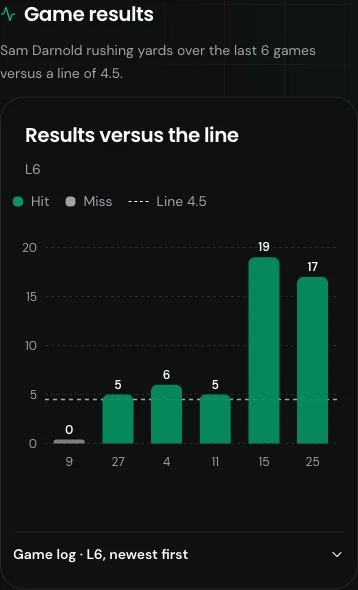
Open the image full size if needed. This is saved research from a settled game, not a current offer. The chart doesn't separate designed runs from scrambles or show carries. Read any available matchup figures with their own position and sample labels; missing evidence isn't zero.
FAQ
What's the best way to research a rushing yards prop?
Start with carries and the player's share of team rushing attempts. Check snaps, efficiency, the spread, injuries and rushing yards allowed to his position. Count games clearing the exact line, recording the sample and dates. Then compare sportsbook prices. A historical hit rate isn't the probability of the next result.
How do you research a quarterback rushing yards prop?
Separate designed runs from scrambles rather than projecting total carries unchanged. Designed runs come from play calls; scrambles depend on passing opportunities, pressure, coverage and the quarterback's choices. Check rushing yards allowed to quarterbacks with a stated window. NFL kneel-downs affect rushing totals; sacks don't subtract from individual rushing yards.
Do carries or yards per carry matter more?
Start with carries: they tell you how many opportunities the player gets. Yards per carry helps assess what those opportunities might produce, but one breakaway run can distort a small sample. Neither is guaranteed. Check whether the workload changed before carrying an old average into a new matchup.
How do you judge a run defense for a rushing prop?
Read rushing yards allowed per game to the player's position, with the window and sample size. Compare yards allowed per carry and the opponents faced. Heavy rushing volume can inflate yards allowed without poor per-carry results. Team-wide totals aren't interchangeable with running-back or quarterback totals, and neither predicts one player's output.
What happens to a rushing yards over if the player has 0 carries?
If he participated and recorded zero rushing yards, Bet Check counts that zero as a miss against a positive over line. Not playing is different from playing without a carry; don't replace nonparticipation or missing stats with zero. Your sportsbook's participation and injury rules control settlement, not Bet Check's historical count.
Check the line before you decide
Check a rushing yards prop free. Confirm the sample, quote timestamp and sportsbook availability, then add injury and workload context. Browse the NFL player hub or today's NFL props; use the receptions guide for catches.
WagerLens is a research tool, not a sportsbook.
Gamble responsibly · 1-800-GAMBLER
See it live before you bet
NFL props with best prices, hit rates with sample sizes, and a public track record.
- Every pick graded — wins and losses, no filters
- Hit rates for the exact line and recent windows
- Sportsbook price comparison on free Bet Checks
- Premium adds tracking, history and stats, and alerts
- Public track record with wins and losses