
Betting calculators guide: parlay, odds converter, hedge, and vig
Sportsbooks make placing a bet effortless and understanding it slightly annoying. That asymmetry is not an accident.
The WagerLens calculators close the gap for four common cases. All four are free, run instantly in the browser, and don't require an account.
The four tools
| Calculator | The question it answers |
|---|---|
| Parlay calculator | What does this parlay actually pay, and what am I really needing to hit? |
| Odds converter | What is this price in American, decimal, fractional, and implied probability? |
| Hedge calculator | Exactly how much do I bet the other side to lock profit or cut a loss? |
| Vig calculator | How much is the book charging me on this line? |
Parlay calculator
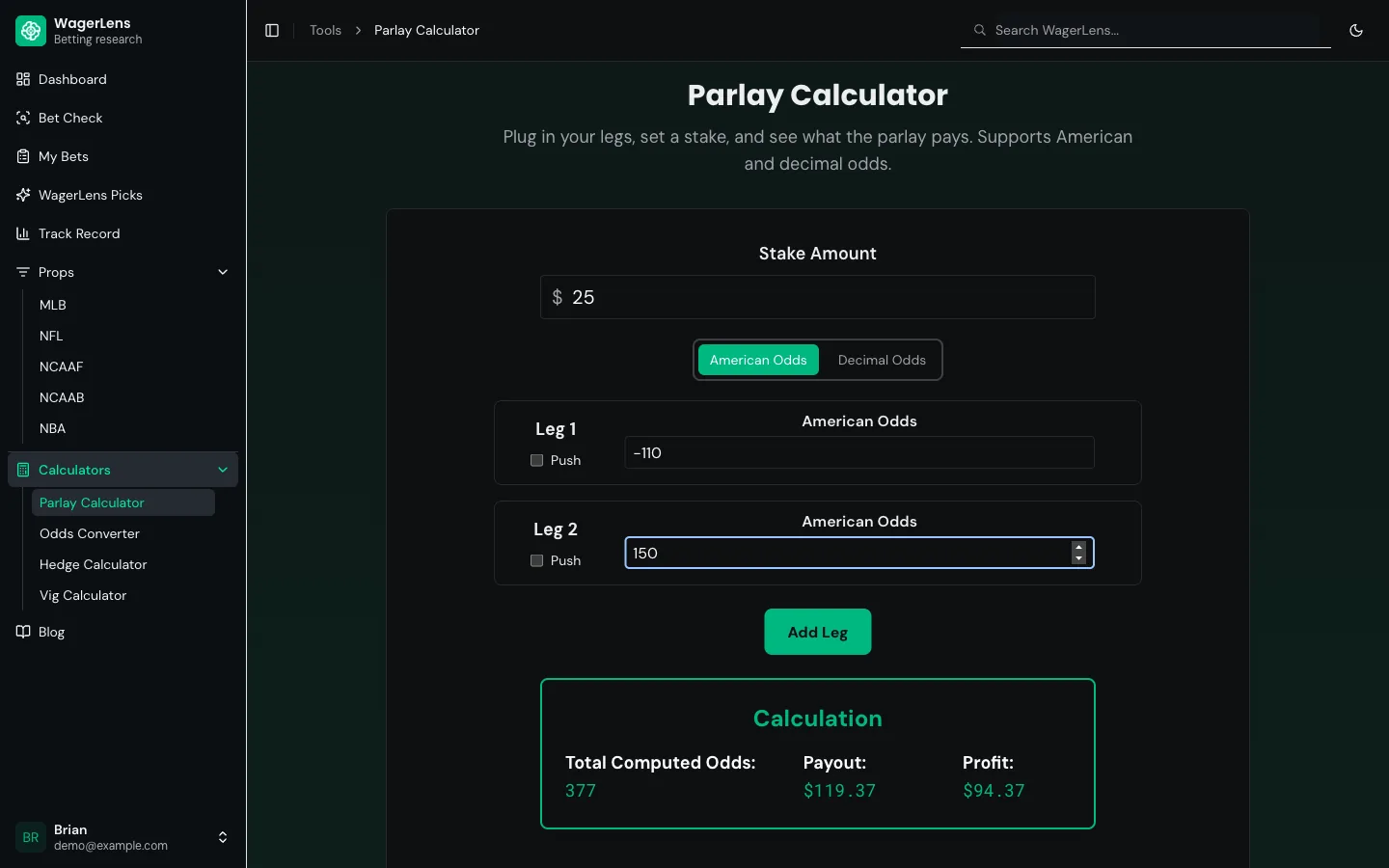
Enter each leg's odds and your stake; get the combined price and payout. Supports American and decimal odds.
Use it before you place any parlay, and especially before you place one a book has "boosted."
It makes the ugly part visible: parlay probability compounds fast in the wrong direction. A −110 leg needs to win about 52.4% of the time just to break even. String four of them together and all four land only about 7.5% of the time, and the book's margin compounds along with the legs. The calculator won't stop you betting parlays. It will stop you thinking a 6-leg parlay is a reasonable weekly plan.
Related reading: maximize wins with two-leggers.
Odds converter
Convert between American, decimal, fractional, and implied probability instantly.
Use it any time you're comparing prices in different formats, or you want the break-even rate behind a number.
The useful part is the break-even rate. −110 is 52.4%. −200 is 66.7%. +150 is 40%. Once you internalize that a price is a required win rate, "is this a good number?" becomes a question you can actually answer.
WagerLens shows implied percentages next to prices in Bet Check results for the same reason. Remember that implied probability is a break-even rate derived from the price, not a prediction.
Hedge calculator
Enter your original bet and the current price on the other side; get the exact hedge stake and your outcome either way.
Use it when a live bet has moved your way and you're considering locking something in, or you want to cap a loss on a parlay with one leg left.
It makes the cost obvious. Hedging is a real decision, not a free win. The calculator shows both outcomes so you can see exactly what you're giving up on the good branch to protect the bad one. Eyeballing a hedge is how people accidentally guarantee themselves a loss.
Related reading: cash out: when to take or hold.
Vig calculator
Enter both sides of a market; get the vig, the fair odds, and the true implied probabilities with the margin stripped out.
Use it when you're comparing two books on the same market, or checking whether an alt line is priced reasonably.
It puts the book's cut in plain sight. A standard −110/−110 market carries about 4.5% vig, and the two sides sum to 104.8% instead of 100%. That extra 4.8% is the book's cut. Some markets, including heavy favorites, long-shot props, and same-game parlays, carry dramatically more.
This is the most underused of the four. If you're betting a market without knowing its vig, you don't know your real break-even rate.
Using them together
A realistic sequence:
- Vig calculator — is this market priced fairly at all?
- Odds converter — what win rate does this price require of me?
- Compare that requirement to the evidence from Bet Check.
- Parlay calculator — if you're combining legs, confirm the payout justifies the compounding risk.
- Hedge calculator — later, only if the situation actually calls for it.
Use them for the math
The calculators are built for arithmetic. They don't know anything about the game, the players, or whether your bet is any good. A calculator can tell you a parlay pays +1200; it can't tell you the legs are correlated in the wrong direction.
For the judgment part, pair them with the research side of WagerLens: Bet Check for the evidence behind a specific bet, the props board for finding candidates, and My Bets for finding out whether any of it is working.
Where to go next
- Open the calculators
- Understanding odds
- Sportsbook prices and line shopping guide
- Sports betting glossary
- Bankroll management
Last reviewed: September 5, 2026 · Owner: Brian McAbee
See it live before you bet
Use calculators and bet checks when the board doesn't answer the question directly.
- Every pick graded — wins and losses, no filters
- Hit rates for the exact line and recent windows
- Sportsbook price comparison on free Bet Checks
- Premium adds tracking, history and stats, and alerts
- Public track record with wins and losses