
WagerLens Picks user guide: what a recommendation actually is
WagerLens Picks is a short list of recommendations where every one shows its underlying data, keeps its original price, and gets graded in public whether it wins or loses.
That's a deliberate choice. A feed of picks with a confident tone and no receipts is already the entire sports betting content industry, and it doesn't need another entry.
Who can see them
WagerLens Picks requires an active Premium subscription. The track record of how those picks have performed is public and needs no account at all, so you can audit the results before you pay for the picks.
What a pick looks like
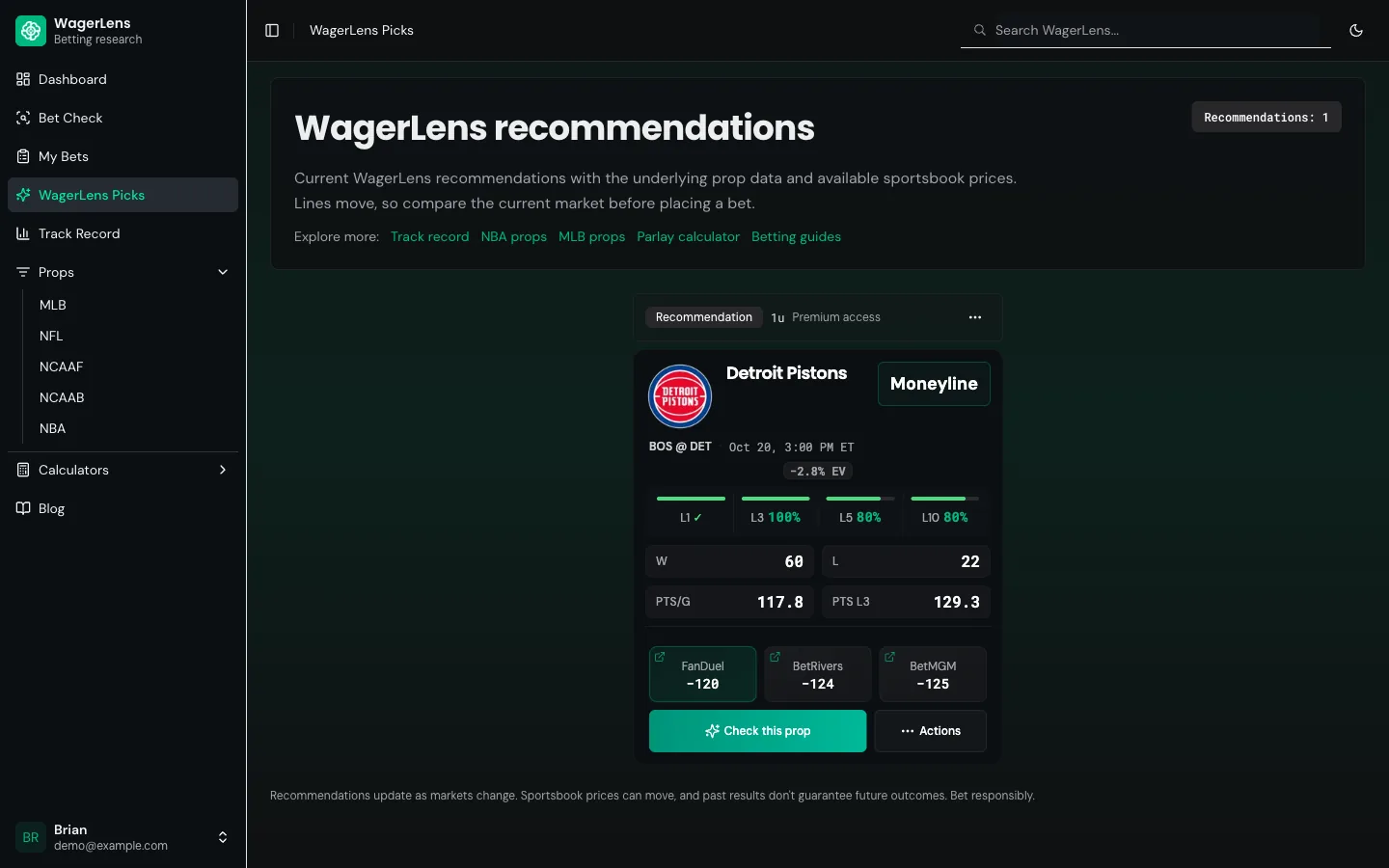
Each card carries:
| Element | What it tells you |
|---|---|
| Recommendation + unit size | The play and how much of a unit it's assigned |
| Subject and market | Who or what, and which market |
| Matchup and start time | The game it belongs to |
| EV read | The value signal at the tracked price |
| Hit-rate chips | L1, L3, L5, L10 recent results with the counts behind them |
| Season context | Records and per-game averages relevant to the market |
| All-book prices | Every book currently offering it, best price first |
| Check this prop | Opens the full Bet Check evidence view |
| Actions | Includes Track Bet |
The page header says the thing that matters most: lines move, so compare the current market before placing a bet. A recommendation made at −120 is a different bet at −145.
How to read one properly
Start with the unit size. A pick assigned 1u and a pick assigned 0.5u are not making the same claim. The unit is the confidence statement.
Then check the price you can actually get. The card shows the best available book. If your book is meaningfully worse and you can't get the listed number, the value that justified the pick may not exist for you. This is the single most common way people turn a decent recommendation into a bad bet.
Look at the sample next. Hit-rate chips show counts, not just percentages. "L10 80%" means 8 of 10. Ten games is a small sample in every sport we cover.
Then hit Check this prop and read the evidence yourself. If the evidence says the sample is thin, a price needs checking, or data is missing, weight it accordingly. Disagreeing with a recommendation after reading its evidence is a completely legitimate outcome, and honestly it's the behavior we'd rather encourage.
Picks vs Bet Check vs My Bets
People conflate these constantly. They're three separate things:
| What it is | Who chooses the bet | |
|---|---|---|
| Picks | Recommendations WagerLens publishes and grades publicly | WagerLens |
| Bet Check | Evidence for any bet you type in | You |
| My Bets | Your personal record of bets you tracked | You |
The natural loop: read a pick, Check it, decide, track it. Your record in My Bets then reflects your decisions, not ours.
How to treat a pick
A pick gives you a recommendation with evidence attached. It is not a lock, a guarantee, or a prediction of the outcome. The page footer is blunt about it: recommendations update as markets change, sportsbook prices can move, and past results don't guarantee future outcomes.
Recommendations also aren't permanent. They reflect the market at the time they were published. If a line has moved several cents against the pick since it went up, the reason it was recommended may have evaporated.
Auditing us
This is the part we'd point at first. The public track record shows every settled recommendation, including the wins, the losses, the losing months, net units, and the methodology behind the calculation. Open picks are excluded from the ledger so nothing can be quietly dropped if it goes bad.
Read that page before you decide whether our recommendations are worth anything to you. If a service won't show you its losing months, that tells you what you need to know.
Where to go next
- Public track record guide — how results are calculated
- Bet Check user guide — verify a pick yourself
- My Bets and bet tracking guide — keep your own record
- Sportsbook prices and line shopping guide — why the price you get decides the bet
- Pricing
Last reviewed: September 5, 2026 · Owner: Brian McAbee
See it live before you bet
Compare prices before you decide whether a number is worth playing.
- Every pick graded — wins and losses, no filters
- Hit rates for the exact line and recent windows
- Sportsbook price comparison on free Bet Checks
- Premium adds tracking, history and stats, and alerts
- Public track record with wins and losses