
How a backup quarterback changes player props: whose games are in the sample?

When the starting quarterback changes, a receiver's or running back's hit rate mostly describes games someone else threw in. Before you trust "5 of 6," list which quarterback played each game and how many snaps he got. A relief appearance or a zero-yard start is not a starter's sample, and the price can move before the hit rate does.
The examples below come from settled games in Weeks 1 through 9 of the 2026 NFL season. Pages and starters were re-checked on November 19. They're research examples, not picks.
Step 1: Whose games are in the sample?
A hit rate is a count of games against a line. "Under 6.5 receptions in 5 of 6" means the player stayed under in five of his last six games. It doesn't tell you who was throwing to him.
Take Justin Jefferson's Under 6.5 receptions check for Minnesota's Week 9 game against Buffalo on Nov 9. Kyler Murray was out with a hamstring strain, and Carson Wentz started. The check showed 5 of 6 (83%) from Sep 13 to Nov 1.
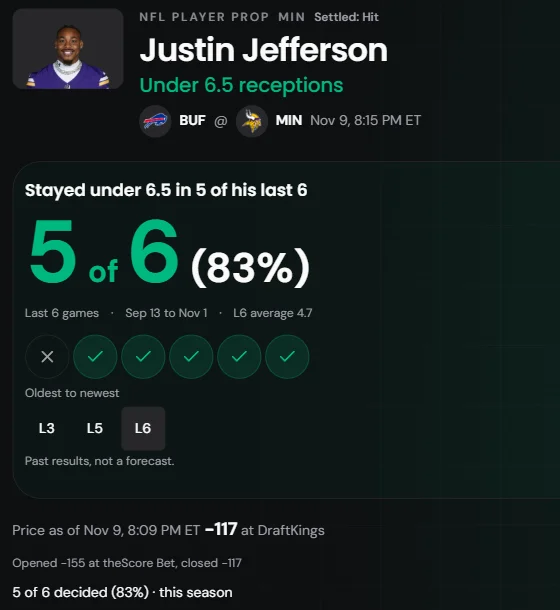
Now add a quarterback to each game, using team and league injury reports:
| Game | Catches | Quarterback |
|---|---|---|
| Sep 13 vs GB | 8 (miss) | Murray 11 snaps, then Wentz |
| Sep 20 @ CHI | 3 (hit) | Wentz start |
| Sep 27 @ TB | 2 (hit) | Murray |
| Oct 11 @ NO | 6 (hit) | Murray |
| Oct 25 vs IND | 4 (hit) | Murray |
| Nov 1 @ DET | 5 (hit) | Murray, played hurt |
The cover chart shows the same six games against the line (open it full size).
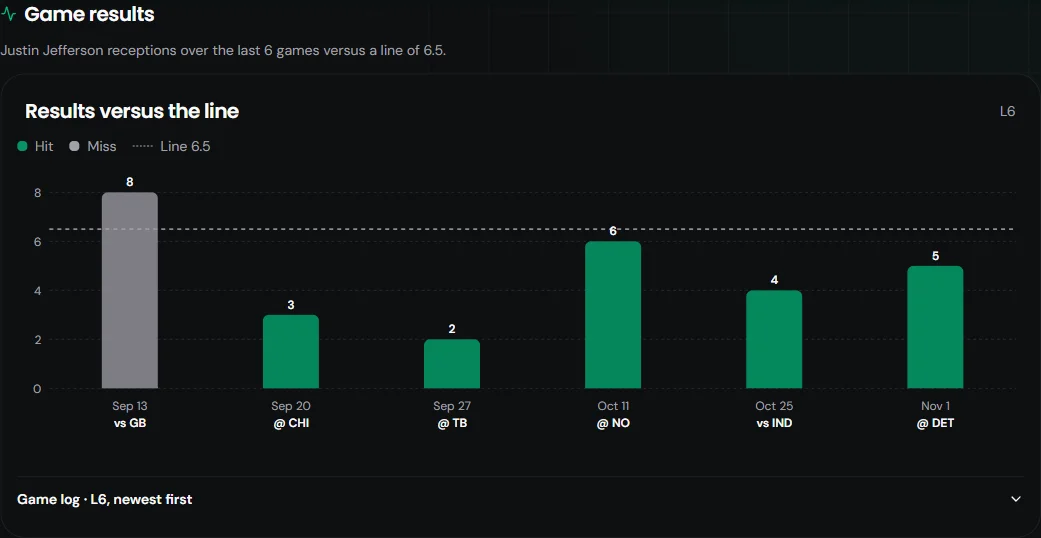
With labels on it, the 5 of 6 splits apart: four hits in Murray's full starts, one hit in Wentz's only start, and the only miss in the game they split. The Wentz-only evidence for Week 9 was one game.
The under hit at 3 catches. That doesn't make the six-game number right after the fact; it still described mostly Murray's games.
The habit: write the starting quarterback next to each date and mark any game he left early or entered off the bench. Short windows are already noisy, as our hit-rate guide explains. A quarterback change means the window no longer describes one passing game.
Step 2: Relief appearances and zero-yard games aren't a starter's sample
Appearing in a game isn't the same as starting it. Wentz's Week 1 game looks normal in his log: 133 passing yards and three touchdowns. He threw all of them after replacing Murray 11 snaps in.
Baltimore's Week 8 game at Buffalo is messier. Lamar Jackson hurt his thumb on the Ravens' first offensive snap. Tyler Huntley replaced him and then hurt his toe, and undrafted rookie Joe Fagnano finished the game. Zay Flowers had 0 catches on 5 targets that day. That row is part of every Flowers hit rate that covers Week 8, but it doesn't describe Jackson, Huntley or a planned Fagnano start.
Quarterbacks' own pages have the same problem. On Nov 19, J.J. McCarthy's Giants page featured Under 1.5 passing touchdowns, hit in 5 of 5. One of those five is Oct 11 at Washington, where his log shows 0 passing yards and 2 rushing yards. A zero-yard game says nothing about his touchdowns in a full start.
WagerLens currently counts these games like any other and doesn't mark them as partial. Look for them yourself: a passing total near zero, a backup's big numbers in a game he entered late, or a game you know ended early for the starter.
Step 3: What a quarterback change can affect
We don't put numbers on these, because there's no reliable universal backup adjustment.
Passing volume. A backup may throw less, or the team may lean on the run. That can cut receiving yards and catches, and raise a running back's carries, unless the team falls behind and has to throw.
Who gets the targets. A target is a pass thrown to a specific player. A struggling offense sometimes funnels more of its targets to one receiver. As our injury guide puts it, a bigger share of a smaller passing game can still produce fewer yards.
The new quarterback's own props. A backup with a few starts has a tiny sample, like Drew Lock's below. Our guide to props with little history covers how to read samples that small.
A trade creates the same problem. Minnesota acquired Kirk Cousins from Las Vegas on Nov 10. On Nov 19, the 10-game window behind his featured passing-attempts line still held nine Raiders games.
None of this means you should take every under when a backup starts. The useful questions are what changed in the passing game and whether the line already reflects it.
Step 4: Watch the price, not just the streak
A hit rate looks backward. The price can change while the stored sample stays the same.
On that Jefferson Under 6.5 check, the price opened at −155 at theScore Bet and closed at −117 at DraftKings (prices as of Nov 9, 8:09 PM ET). The under got cheaper. At −155, you need to win about 60.8% of the time to break even: 155 divided by 255. At −117, you need about 53.9%: 117 divided by 217.
Two cautions: the open and close come from different sportsbooks, and the check doesn't say why the price moved. It does show the break-even rate shifting by about 7 percentage points while the 5 of 6 stayed put. Our guide to how prop prices move covers reading a move without assuming its cause.
Compare the current price with the open on the same check, then ask whether the sample still fits the game being played.
Case files: Weeks 8 and 9
Dated examples of what the habit finds, not what to bet next.
Zay Flowers, Baltimore. Week 6 and Week 7 (66 and 137 receiving yards) came before Jackson's injury. Week 8 was the three-quarterback game at Buffalo (0 yards). Week 9 was Fagnano's first start (6 yards on 3 catches). Jacoby Brissett started Week 10, so the window on his player page now spans four quarterback situations.
Justin Jefferson, Minnesota. In Week 9 with Wentz, he caught 3 passes for 58 yards on 11 targets, and his Over 79.5 receiving yards check settled a miss. With Cousins starting from Week 10, his player page mixes Murray, Wentz and Cousins games in one window.
Drew Lock, Seattle. Lock started Weeks 9 and 10 with Sam Darnold injured. On Nov 19 his page showed four games this season and no props for Seattle's next game. When they appear, his sample is four games and his receivers' samples are mostly Darnold's.
If the listed starter is ruled out after you bet
The sportsbook's rules decide voids. If a quarterback never plays, his own props are usually void; if he plays one snap and gets hurt, they may stand. A receiver's props usually stay live through a quarterback change unless the book's rules say otherwise. Our guide to what happens when a player doesn't play covers those rules.
How to check it on WagerLens
- Open the receiver's, back's or quarterback's player page from the NFL player hub and read the game log date by date.
- Label each game with the starting quarterback from a team or league report. Flag relief and zero-stat games by hand.
- Open the exact line on Bet Check, not a nearby one.
- Read the hit rate with its sample size, and count how many of those games involved the quarterback who's starting now.
- Compare the open price with the current price. The free check shows the best sportsbook price; the full 8-book comparison is Premium.
- Use Save this check (free with an account) so you can see how it settled and which games were in the sample.
Related reading: NFL player prop hit rates, hot streaks and regression, NFL receptions props and how to research NFL player props.
FAQ
How does a backup quarterback affect wide receiver props?
It can change how often the team throws, who gets the targets and how deep the passes go. A bigger share of a smaller passing game can still mean fewer yards. There's no single backup rule, so tag each game in the receiver's log with its quarterback and see how much of the hit rate belongs to the old starter.
Should I trust a receiver's hit rate after a QB change?
Only after you know whose games are in it. Before Carson Wentz's Week 9 start, Justin Jefferson's Under 6.5 receptions showed 5 of 6. Four of those games were Kyler Murray starts, one was a Wentz start and one was a game Murray left after 11 snaps. Reread the number with those labels.
Does one relief appearance tell me anything about a backup QB's props?
Very little. Coming off the bench is a different job from starting: fewer snaps, a different game situation and often a game plan built for someone else. WagerLens counts those games like any other, so spot them yourself. Look for a near-zero passing total or a game you know he entered late.
Do sportsbooks adjust prop lines when the starting QB is out?
They can change the line, the price or both, sometimes before the hit rate has any games with the new quarterback in it. A price change doesn't tell you its cause or which side is right. Compare the current price with the open on the same check, then decide whether the stored sample still fits.
What happens to my QB prop if the listed starter doesn't play?
If he never takes a snap, his own props are usually void, but the sportsbook's participation rules decide that, not WagerLens. Receiver and running-back props usually stay live through a quarterback change. Our guide to what happens when a player doesn't play covers voids, injuries and early exits.
How do I check which quarterback played in each game on WagerLens?
Open the player's game log and match each date with the team's starter from an official team or league report. WagerLens doesn't currently label each row with the quarterback or flag relief games, so you have to do that matching yourself. Then open the exact line on Bet Check and reread the sample.
Check a prop free, then tag the games before you trust the number.
Research, not picks. Past results aren't a forecast. Gamble responsibly · 21+ · 1-800-GAMBLER
See it live before you bet
NFL props with best prices, hit rates with sample sizes, and a public track record.
- Every pick graded — wins and losses, no filters
- Hit rates for the exact line and recent windows
- Sportsbook price comparison on free Bet Checks
- Premium adds tracking, history and stats, and alerts
- Public track record with wins and losses