
NBA Minutes Restrictions and Blowouts: How Projected Minutes Change a Player Prop

Every NBA counting-stat prop assumes a minutes number. A cap, foul trouble or a blowout can leave the line priced for minutes a player won't get. WagerLens game logs show points, rebounds and assists, not minutes, so you have to check short nights yourself rather than count them as full games.
The examples below use Rudy Gobert's logs, pulled November 19, 2026, plus box scores from Basketball-Reference. Start with the exact line on Bet Check, then use this post to decide how far to trust its sample.
Every counting-stat prop assumes minutes
Points, rebounds, assists, threes and the combo lines built from them are counting stats. They only add up while the player is on the floor. For points, think of three pieces: how often he uses a possession, how well he scores with it, and how many minutes he gets. The usage rate guide covers the first piece. This post is about the last one.
Minutes can change on short notice. A coach's limit, foul trouble or a game that's decided early can cut a night short before the line knows.
Combo props such as points plus rebounds plus assists share the same minutes, so a short night hits all three pieces. The combo props guide has more.
So the first research question isn't "what's his average?" It's "how many minutes does this line assume, and is anything about to change that?"
Where minutes news shows up
The prop board rarely says it. Look in these places:
- Coach comments before the game or the night before, usually relayed by team beat reporters.
- The official injury report, for availability. Don't assume it states a minutes target.
- Return-from-injury plans. A player coming back can be on a workload plan that lasts more than one game.
- In-game events you can't know before tip-off: early fouls, an ejection, an injury or a starter pulled in a blowout.
Write down the source and when you read it, because a comment from the night before can be stale by tip. The rest and schedule guide covers back-to-backs. For a player ruled out entirely, see what happens to a prop if the player doesn't play.
What WagerLens shows, and what it doesn't
WagerLens NBA player pages list points, rebounds and assists for recent games. A check plots points against the line. Neither shows minutes, and nothing on the page marks a game as short.
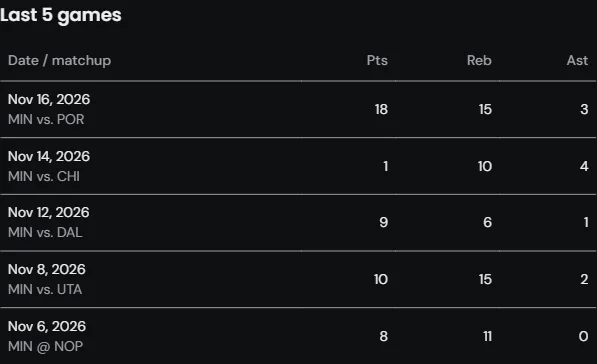
Captured November 19, 2026, from Gobert's player page. Open the image to see it full size.
How to read a game log without minutes
Take Rudy Gobert's Under 9.5 points against Utah on November 8. The saved check shows him under the line in 5 of 7 tracked games (71%), and the bet settled as a miss: he scored 10. The chart at the top of this page is that check. One of its bars is a single point, against Golden State on October 28.
Was that a short night or a cold one? The chart can't say. The box score can. Basketball-Reference has Gobert at 20:19 that night: 0 for 4 from the field, 1 for 2 on free throws, 4 rebounds and 3 fouls. He played more than 20 minutes. It wasn't a brief appearance.
The player page above shows a second case: 1 point against Chicago on November 14. Its 10 rebounds and 4 assists hint that he was on the floor for a while, and the box score confirms 26:53 and an 0-for-7 night from the field.
A points-only log makes both games look like nights he barely played. Neither was. The choice matters, too: drop the Golden State game and 5 of 7 (71%) becomes 4 of 6 (67%). Here the box score says to keep it. For a different 1-point game, it might not.
When a counting stat looks tiny next to the player's usual range, find the minutes in a box score before you let that game vote in a hit rate. Rebounds and assists can hint; they don't settle it. If you can't find the minutes, mark the game unverified instead of counting it as a normal hit or miss.
Don't let a short night pass as a typical one
A hit rate counts games against a line. Say a player left after four minutes and finished under his points line. The Under hit, but that result says nothing about a 32-minute night, and it makes a number like "5 of 7" look more typical than it is.
Bet Check doesn't read minutes, so a game he left early counts like any other tracked game in the sample. You'll have to spot it. Not every short night deserves the same treatment, though. This is our judgment, not a rule:
| Why the night was short | How to treat it |
|---|---|
| Injury exit or ejection | A one-off. Set it aside and say you did. |
| Blowout rest | A real outcome that can come back when the game script does. Keep it and note the margin. |
| Foul trouble | Can repeat for some players and matchups. Keep it, then check whether it's a pattern. |
| A limit after returning from injury | A different role. Compare it only with games under a similar limit. |
Sample size still applies. The hit rate guide explains why seven games leave a lot of uncertainty.
Blowouts and the spread
In a lopsided game, either team's starters can sit the fourth quarter, and bench players can gain those minutes. The risk to a starter's Over is that lost time.
The spread is a clue, not a switch. WagerLens doesn't publish a margin where "blowout minutes" begin, and this post doesn't invent one. A big favorite can still be in a tight game, and a small favorite can still run away. The useful habit is to notice when the market already expects a lopsided game, then ask who loses minutes and who might gain them if that script arrives.
Don't double count. If the spread and total already point to a comfortable win, some of that minutes risk may already be in the player's line.
Who picks up the leftover minutes
When a starter is limited, sits with fouls or leaves a blowout early, his minutes usually go to the next players in the rotation, not automatically the team's top scorer. Minutes and shots are separate questions.
The injuries guide explains why a missing player's work gets split among several teammates. A backup who gains a few minutes doesn't inherit a starter's whole points line.
The 12-minute under rule
ESPN reported that a league memo sent to sportsbook partners on October 16, 2026 told authorized operators, including DraftKings and FanDuel, not to offer unders on players expected to play fewer than 12 minutes in a specific game.
For research, that means a missing Under on a deep reserve may be a rule, not a signal about the player. As reported, the rule covers unders only. How each book decides who's expected under 12 minutes isn't something WagerLens can tell you, so confirm at your book.
How to use this on a WagerLens check
- Open the exact line on Bet Check and confirm the player, side and number. The Bet Check guide walks through each section.
- Read hits and games together, then switch between the available windows.
- Scan the game log for tiny counting lines and look up those games' minutes before you let them vote.
- Check today's news for a coach's limit, a back-to-back or a game the market expects to be lopsided.
- If a teammate is out or limited, ask who actually gets the minutes, not just the shots.
- Compare the price. The free check shows the best tracked price; Premium compares all eight books. Confirm it at the sportsbook.
Find a line on today's NBA props or the NBA player hub. To come back to the research, choose "Save this check"; a free account is required. Saving doesn't require placing a bet, and passing is a valid result.
FAQ
How do minutes restrictions affect NBA player props?
A limit shortens the time a player has to add up points, rebounds, assists or threes, so a line priced for a normal workload can be too high. The news usually comes from a coach or team reporter, not the prop board. Check the limit first, then the hit rate, and be careful with games he left early.
Does WagerLens show minutes on player pages or checks?
Not today. NBA player pages and Bet Check game logs show points, rebounds and assists, not minutes, and they don't mark short games. A 1-point game could be a brief appearance or a long, cold night. Look up minutes in a box score before counting that game as a normal sample.
Should a game a player left early count in a hit rate?
Not as a typical night. If he played four minutes and finished under his points line, the Under hit, but the result says little about a normal shift. Bet Check counts it like any tracked game, so spot those games yourself and read the rate with that in mind.
How do blowouts change starter and bench props?
Starters on either team can lose fourth-quarter minutes in a lopsided game, and bench players can gain them. The spread hints at that script but doesn't guarantee it. Don't fade every starter on a big favorite or back every reserve without checking the rotation and what the line already assumes.
Why did the under disappear on a low-minute player?
ESPN reported that the NBA told authorized sportsbooks on October 16, 2026 not to offer unders on players expected to play fewer than 12 minutes in a game. If an Under is missing at your book, that may be why. Confirm with the book, since WagerLens can't see its expected-minutes call.
What's the difference between a minutes limit and a usage change?
A limit is about time on the floor. Usage is the share of plays a player finishes while he's out there. A player can keep his usual usage and still finish under his points line if he plays 18 minutes instead of 32. Check minutes first, then usage, then the price.
Research, not picks. Past results aren't a forecast. Gamble responsibly · 21+ · 1-800-GAMBLER
See it live before you bet
NBA props with best prices, hit rates with sample sizes, and a public track record.
- Every pick graded — wins and losses, no filters
- Hit rates for the exact line and recent windows
- Sportsbook price comparison on free Bet Checks
- Premium adds tracking, history and stats, and alerts
- Public track record with wins and losses